Meta's AI Writes the Ad. You Own the Risk.
Two quiet platform changes landed in October. Meta's new ad terms make advertisers answer for the AI creative Meta's own tools produce, and HighLevel changed what counts as a "checkout". One shifts who is responsible for your ads, and the other shifts what your numbers mean.

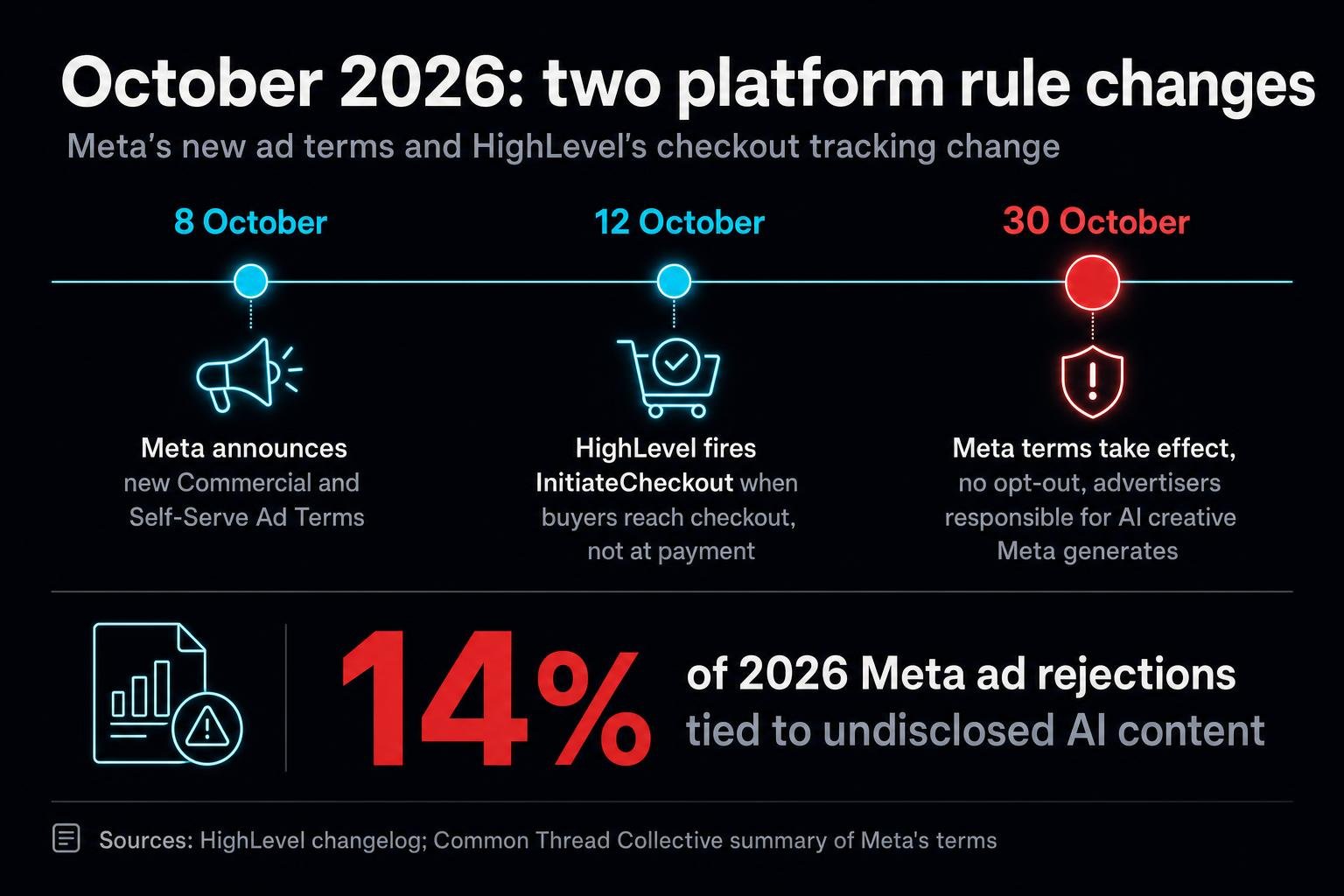
Two things changed this month in the plumbing of online advertising, and neither got a press conference. One changes what your numbers mean. The other changes who is responsible for your ads. If you run, buy or report on digital ads, both are worth ten minutes before the end of October.
Meta's new terms: the robot drafts, you sign
On 8 October, Meta announced updates to its Commercial Terms and Self-Serve Ad Terms. They take effect on 30 October 2026. You don't click anything to accept them and you can't opt out. If you keep advertising after that date, you have agreed.
Common Thread Collective, an ecommerce growth firm, read the new terms closely. By their reading, the terms do four notable things:
- You own what Meta's AI makes. Advertisers are responsible for changes made by Meta's automation and AI, including creative, targeting and placement that Meta itself generates.
- The labels stay on. Removing AI watermarks or authentication metadata is prohibited.
- Tests without notice. Meta may run tests that affect delivery, targeting, pricing, reporting and creative without telling you first.
- Your website becomes training material. Meta gains broad rights to crawl advertiser websites and use that content for training.
The first point is the one that made me sit up. Picture a valet who decides, without asking, that your car needs a new paint job, then takes it for a spin and gets a speeding ticket. Under these terms, the ticket has your name on it.
The platform is now both the copywriter and the bystander. It can write the line, and you carry the consequences of what the line says.
This matters most where words carry legal weight: health, finance, or any product making claims a regulator cares about. An automated tool that "improves" a headline can turn a careful, compliant sentence into a promise the brand is not allowed to make. The new terms put the responsibility for that sentence squarely on the advertiser.
The same source cites a figure that 14% of 2026 Meta ad rejections were tied to undisclosed AI content. That is their number, not an audited one, but it points the same way. AI content is already something Meta enforces against, and the rules around it are getting tighter.
One honest caveat: my source is Common Thread Collective's summary, not the terms text itself. If you spend real money on Meta, read the actual terms before the 30th.
HighLevel moved the finish line on "checkout"
The second change is smaller, more technical and in some ways sneakier. HighLevel, the marketing platform many small businesses and agencies use to run funnels and stores, posted a changelog entry on 12 October about when it fires Meta's InitiateCheckout event.
Before, that event fired when a buyer submitted payment. Now it fires when a buyer reaches checkout: when a store checkout page loads, or on the first click or keystroke in an order form. HighLevel says it plainly: "InitiateCheckout counts will go up."
Think of a gym that used to count visitors at the treadmill and now counts them at the front door. Far more people walk through the door than ever step on a treadmill, so the number jumps overnight. Nobody got fitter. The counter moved.
HighLevel did build in sensible guardrails. The event fires at most once per page visit. It ignores browser autofill and auto-focused fields, so a page that fills itself in doesn't count as a person starting checkout. On abandoned-cart links it waits for the saved cart to load. Express buyers using Apple Pay style buttons still count once payment starts. Consent handling and Conversions API deduplication are unchanged. The change applies automatically, but page-level settings can take up to 24 hours to reach already-published pages unless the page is edited and saved.
The AddPaymentInfo event also got richer. It now sends order value, currency, product IDs and hashed email, phone, name and external ID.
Why a bigger number can mislead you
Here's the trap. From around 12 October, anyone running HighLevel funnels with InitiateCheckout enabled will see that metric jump with no change in what buyers actually do. Cost per InitiateCheckout will fall. Checkout-to-purchase rate will fall. Someone glancing at a dashboard could conclude that "ads got cheaper" or that "checkout got worse." Both readings are wrong.
Automated rules and ad sets that optimize on InitiateCheckout are also now getting a broader, earlier signal than they were getting the week before.
There is a real upside hidden in here. InitiateCheckout now fires when someone arrives and AddPaymentInfo fires when they enter payment details, so the gap between the two is real drop-off: people who reached checkout and walked away. That gap used to be invisible. Now you can see where buyers hesitate.
The bigger pattern
Side by side, the two changes share a theme. The platforms we build businesses on are not neutral pipes. They take part. They generate creative, redefine metrics and keep the right to experiment on campaigns. Most of that arrives through changelogs and terms updates, not headlines.
I find that exciting and a little unnerving in equal measure. The tools are getting more capable, and more capable tools act on their own more often. Knowing how to use these platforms is no longer enough. You also have to notice when they change and ask one plain question each time: who is accountable for what this machine just did?
One practical habit: keep a simple log of platform changes next to your performance reports, with the date and one line on what changed. When a number jumps, the first question should be: did we change, or did the platform?
One signal a day. No noise.
A 3-minute read when something genuinely shifts in AI, automation, or defense tech. Free, most weekdays.
Free, most weekdays. No spam, unsubscribe anytime.Sources
- HighLevel: Changelog - https://ideas.gohighlevel.com/changelog
- Common Thread Collective: Meta's New Ad Terms Take Effect October 30, What Ecommerce Brands Must Know Before the Deadline - https://commonthreadco.com/blogs/coachs-corner/metas-new-ad-terms-take-effect-october-30-what-ecommerce-brands-must-know-before-the-deadline
Quick answers
When do Meta's new ad terms take effect?
Meta announced updated Commercial Terms and Self-Serve Ad Terms on 8 October, and they take effect on 30 October 2026. There is no opt-out. If you keep advertising after that date, you have accepted them.
Are advertisers responsible for ads Meta's AI generates?
According to Common Thread Collective's reading of the new terms, yes. Advertisers are responsible for changes made by Meta's automation and AI, including creative, targeting and placement that Meta generates. Removing AI watermarks or authentication metadata is also prohibited.
Why did my InitiateCheckout numbers jump on HighLevel funnels?
Under HighLevel's 12 October change, InitiateCheckout now fires when a buyer reaches checkout (page load on store checkout pages, or the first click or keystroke in an order form) instead of when they submit payment. HighLevel says counts will go up even though buyer behaviour has not changed.
Does the HighLevel change affect consent or Conversions API deduplication?
No. HighLevel says consent and Conversions API deduplication behaviour are unchanged. The update applies automatically, though page-level settings can take up to 24 hours to reach already-published pages unless the page is edited and saved.