An AI Coworker Now Costs $100 a Month
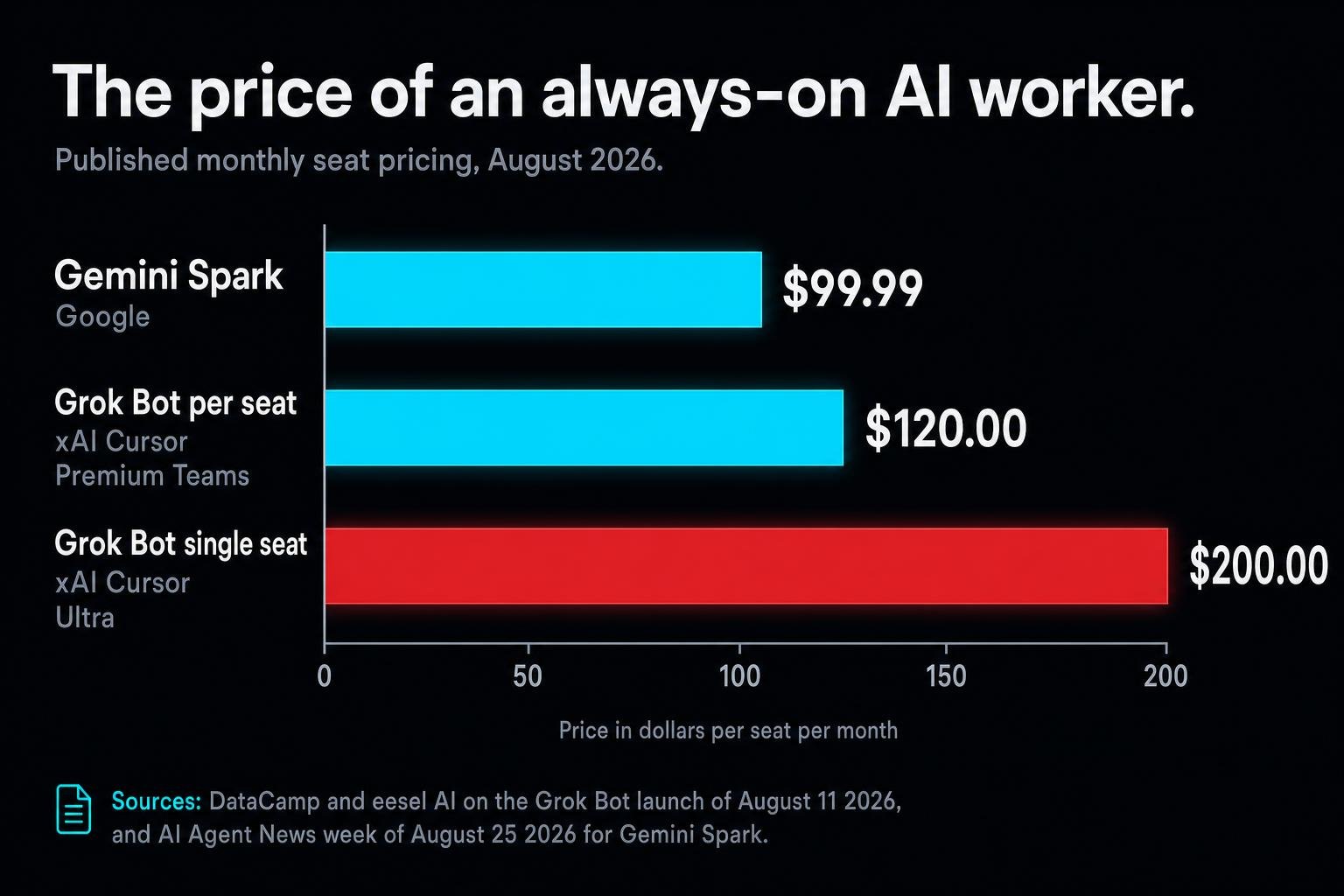
In August 2026 the "always-on AI teammate" category stopped being a demo and got a price tag. Four entrants, and the published numbers land in a surprisingly tight corridor: $99.99 to $200 per seat per month.

For most of the last two years, if you asked what an autonomous AI worker costs, there was no answer. There were demos, waitlists, and a lot of arm-waving about "agentic" futures. There was no number.
This month there is a number. Actually there are three, and what makes them worth staring at is how close together they are.
The number: $99.99 to $200 a month
On August 11, 2026, xAI (credited as SpaceXAI in the launch coverage) shipped Grok Bot, a set of "always-on" AI teammates. Pricing landed at $200 per month on Cursor Ultra, or $120 per seat per month on Cursor Premium Teams, and it comes bundled free for existing SuperGrok Heavy and Cursor Ultra subscribers. On August 27 the same team pushed Grok 4.6 into Microsoft Foundry with a 500k context window, configurable reasoning levels, and explicit support for long-running agents. Grok Bot itself came out of beta and into SuperGrok Plus, SuperGrok Heavy, Cursor Pro+, Cursor Ultra and Cursor Teams.
It is the fourth entrant in a lane that opened in July 2026 with OpenAI's ChatGPT Work and Anthropic's Claude Cowork. The fourth number comes from Google, whose Gemini Spark runs at $99.99 per month for a cloud agent that works 24/7 even when your device is off, manages calendars, and makes real purchases.
Stack them up and you get a corridor: $100 (Google), $120 (xAI teams), $200 (xAI single premium seat). Four independent companies, one lane, and a price band you could cover with a single dinner bill.
The price of an autonomous worker is no longer a thought experiment. It is a line item, and as of this month it sits between one hundred and two hundred dollars a month.
What you are buying is a machine, not a chatbot
Read the Grok Bot description carefully, because the architecture is the actual news. Each agent runs on a persistent cloud Linux virtual machine. It signs into your existing tools with its own session. It browses. It reads and writes files. It takes screenshots. It keeps working after you close your laptop, and it surfaces only when a human decision is needed.
That is not a smarter autocomplete. That is a coworker-shaped container: its own computer, its own logins, its own working hours.
Here is the analogy that made it click for me. For three years we have been renting a very fast consultant who only exists while you are in the room with them. Close the tab and they evaporate, mid-sentence, with no memory of the meeting. What shipped this month is closer to hiring a night-shift operator. You leave a note, you go to bed, and the work is on your desk in the morning, along with three things they were not willing to decide without you.
Why a tight corridor matters more than a low price
When four companies with wildly different cost structures independently price the same thing within 2x of each other, the market has stopped guessing. A wide spread would mean nobody knows what this is worth yet. A tight band means the category has an agreed unit: one seat, one persistent machine, one month.
That has a few consequences worth sitting with:
- The comparison changes. The reference point for "should we automate this" is no longer a vague productivity claim. It is a specific monthly seat cost you can put next to a specific block of recurring hours.
- The runtime is now commodity. The hard infrastructure part, a sandboxed always-on machine that can hold credentials and work unattended, is being shipped by the largest labs as a subscription feature. Building that yourself just stopped being a moat.
- The seat is generic by construction. Horizontal agents are sold to everyone, which means the value that is left is domain knowledge: knowing which work should be handed over, and what the failure modes are when it goes wrong.
The unglamorous half: who exactly did that?
The same week, a quieter document landed. On August 22 the Model Context Protocol maintainers published an updated roadmap naming five priority areas: agentic messaging, HTTP-native transport, agent identity, better primitives, and SDK polish.
Note the third one. "Agent identity" as a named protocol priority means the plumbing is moving toward the agent holding credentials that are distinct from the human it acts for. That sounds like a footnote until you connect it to the architecture above. If an always-on agent is signing into your tools with human-shaped credentials, then every action it takes shows up in the audit log as you. Fine on a Tuesday. Much less fine the first time somebody asks who approved a specific message that went out at 3am.
The two stories are one story. The seat price tells you agents are about to do a lot of unattended work. The identity roadmap tells you the industry already knows the next question is going to be which agent did this, acting for whom, under what grant.
The honest read
I am genuinely excited about this and also unromantic about it. A $120 seat that returns ten hours a month is trivially worth it, and the design decision I like most in the Grok Bot description is the least flashy one: it surfaces when a human decision is needed. That pause is not friction. In anything involving money, health, or a customer's inbox, that pause is the whole product.
The category that was priceless in July has a price in August. The next twelve months are not going to be about whether these things work. They are going to be about which recurring blocks of work get handed over first, and how carefully we log what happens next.
One signal a day. No noise.
A 3-minute read when something genuinely shifts in AI, automation, or defense tech. Free, most weekdays.
Free, most weekdays. No spam, unsubscribe anytime.Sources
- DataCamp - Grok Bot breakdown - https://www.datacamp.com/blog/grok-bot
- eesel AI - Grok Bot - https://www.eesel.ai/blog/grok-bot
- Startup Fortune - SpaceXAI and Cursor launch Grok Bot, an always-on team of AI agents - https://startupfortune.com/spacexai-and-cursor-launch-grok-bot-an-always-on-team-of-ai-agents/
- Releasebot - xAI changelog - https://releasebot.io/updates/xai
- LLM Gateway - model release timeline - https://llmgateway.io/timeline
- AI Agent Store - AI agent news, week of Aug 25 - https://aiagentstore.ai/ai-agent-news/this-week
- Assindo - AI agent news, August 2026 - https://assindo.com/news/ai-agent-news-august-2026
- Model Context Protocol blog - The New MCP Roadmap - https://blog.modelcontextprotocol.io/posts/mcp-roadmap/
- NxCode - MCP roadmap: agent identity, tasks, tool discovery - https://www.nxcode.io/resources/news/mcp-roadmap-agent-identity-tasks-tool-discovery-2026
Quick answers
What does an always-on AI agent seat cost in August 2026?
The published numbers sit in a tight corridor. Google's Gemini Spark is $99.99 per month. xAI's Grok Bot is $120 per seat per month on Cursor Premium Teams, or $200 per month on Cursor Ultra, and it is included free for existing SuperGrok Heavy and Cursor Ultra subscribers.
What is Grok Bot and how is it different from a chatbot?
Grok Bot, shipped by xAI on August 11, 2026, is a set of always-on AI teammates that run on a persistent cloud Linux virtual machine. They sign into your existing tools, browse, read and write files, take screenshots, and keep working after you close your laptop, surfacing only when a human decision is needed.
Who else is in this category?
It is a four-entrant lane. OpenAI's ChatGPT Work and Anthropic's Claude Cowork opened it in July 2026, Google joined with Gemini Spark, and xAI's Grok Bot is the fourth. On August 27, 2026 xAI also pushed Grok 4.6 into Microsoft Foundry with a 500k context window and explicit support for long-running agents.
Why does agent identity matter for these products?
On August 22, 2026 the Model Context Protocol maintainers named agent identity as one of five roadmap priorities, alongside agentic messaging, HTTP-native transport, better primitives and SDK polish. It matters because an always-on agent using human credentials makes every action look like the human took it, which becomes a problem the moment someone needs to know which agent acted, for whom, and under what authorization.