Meta's New Open Model Is Built to Use Tools
Meta's Muse Spark Open is an 816B open-weight model that tops Meta's own tool-use table and runs on two desktop Macs. It is not the best open model overall, and the fine print in its license matters as much as the benchmarks.
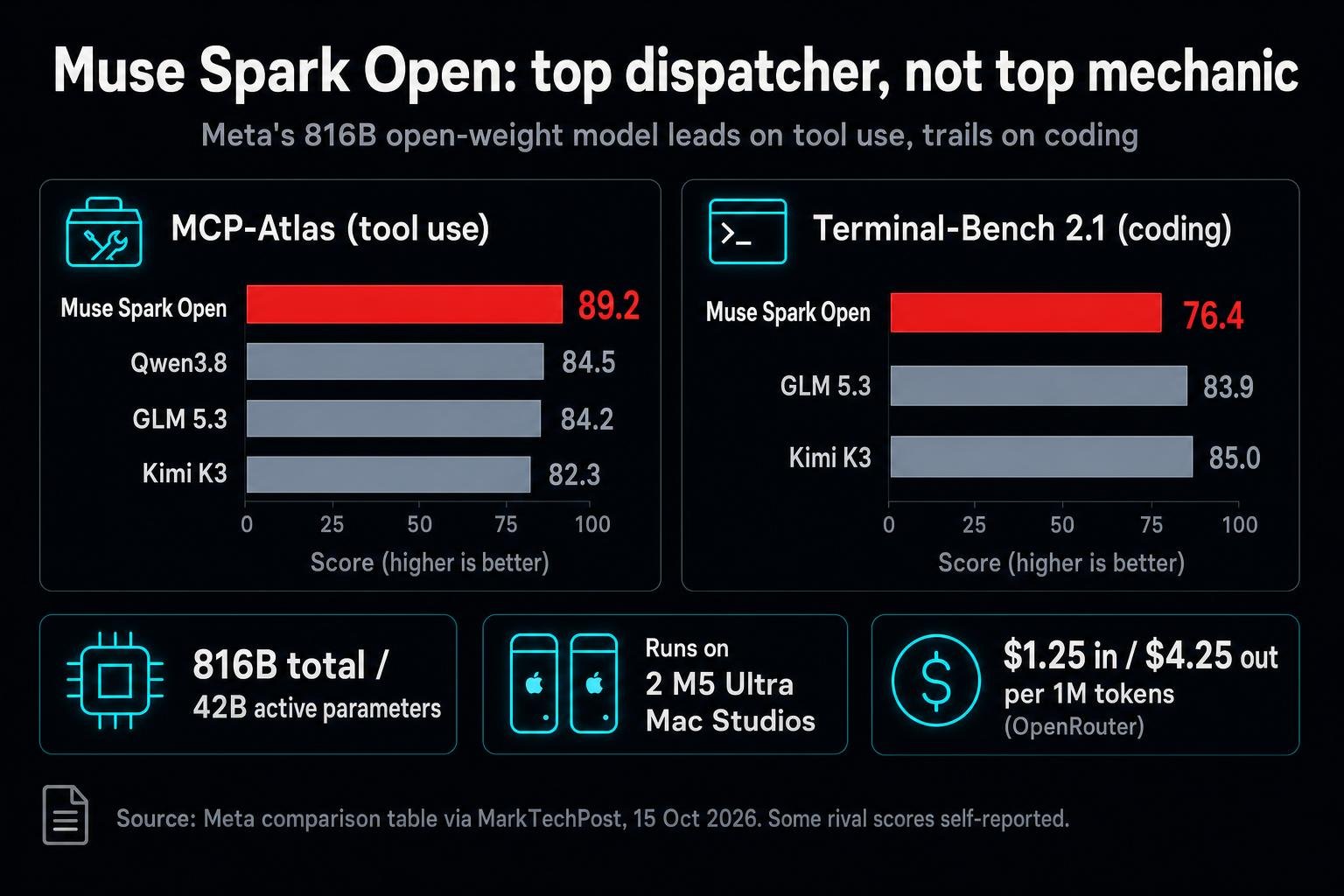
For most of the past year, if you wanted a downloadable AI model that was really good at operating tools, the names at the top of the charts were Chinese. On 15 October, Meta changed that. Meta Superintelligence Labs released Muse Spark Open, an 816-billion-parameter model with public weights. On Meta's own comparison table, it ranks first on MCP-Atlas, a benchmark that measures how well a model calls tools through the Model Context Protocol.
That is a narrow win, and I want to be precise about it. It is also the narrow win that matters most right now, because tool use is the skill that turns a chatbot into an agent.
What Meta actually shipped
- Size: a mixture-of-experts model with 816B total parameters, of which 42B are active for any given token.
- Memory: a 1-million-token context window.
- Inputs: text, image, video and audio in, text out.
- Weights: published on Hugging Face in BF16 and in NVFP4, a compressed 4-bit format.
- Hosted price: OpenRouter lists it at $1.25 per million input tokens and $4.25 per million output tokens.
The dispatcher, not the mechanic
Here is the easiest way I've found to read the benchmark results. Think of an AI agent as a busy repair shop. One skill is dispatching: taking a customer's request, picking the right specialist, filling in the work order correctly and passing the result back. Another skill is being the mechanic: getting under the car and doing the hands-on technical work yourself.
MCP-Atlas measures dispatching. Muse Spark Open scores 89.2 there, ahead of Qwen3.8 at 84.5, GLM 5.3 at 84.2 and Kimi K3 at 82.3. That is a clear gap on the skill agents lean on most: choosing the right tool and calling it properly.
Terminal-Bench 2.1 is closer to measuring the mechanic, meaning hands-on coding work in a terminal. There, Muse Spark Open is behind. It scores 76.4, against 83.9 for GLM 5.3 and 85.0 for Kimi K3. On the broader Artificial Analysis Intelligence Index it scores 39, while GLM 5.3 scores 45.
So the honest headline isn't "Meta builds the best open model." A better one is "Meta builds the best open dispatcher." One more caveat: these numbers come from Meta's comparison table, and some of the rival scores in it are self-reported. Until independent testers repeat the results, treat them as the vendor's claim, not as settled fact.
Muse Spark Open is not the smartest open model. It may be the most useful one for agents, because agents spend most of their time using tools, not writing code.
A data center that fits on a desk
The detail that got my attention is the hardware. According to the release coverage, the compressed NVFP4 version runs on two M5 Ultra Mac Studios using Apple's MLX framework. On server hardware, that's 4 Blackwell Ultra GPUs or 8 H200s.
How does an 816B model fit there? Through the mixture-of-experts design. Picture a huge library with hundreds of specialist librarians, where only a small team works on your question at any moment. The whole library still has to fit in the building, but you only pay for the 42B parameters that are working. Large total size gives the model breadth, and the small active slice keeps it fast and affordable.
For a team that can't send data to an outside API, this shifts the conversation. A tool-calling model near the top of its class can now run on hardware you could put on a desk in your office.
The fine print is part of the product
Open weights don't mean no strings. Muse Spark Open's license allows free use, fine-tuning and distillation. Products built on it must display "Built with Muse Spark Open". Companies that host the model as a service and earn above $20M in revenue need a separate agreement with Meta. Using it to power your own product is exempt from that hosting clause.
That's a smart design. Meta gets a visible badge on every product built with the model, a bit like an ingredient label on a package. And it keeps the right to negotiate with the large clouds that would otherwise resell its work. For most builders, the practical question is simpler: are you comfortable with that label appearing in front of your customers? For internal tools, it may never matter. For a customer-facing app, it's a branding decision to make deliberately, not something to find out after launch.
Why this matters beyond Meta
For a while, the open-model race has been described as a single leaderboard. This release shows it splitting into specialties. One model leads on coding, another on general reasoning, and now a US-origin model leads on tool use. For anyone building agents, the right question has moved from "which open model is best?" to "best at the job my agent actually does all day?"
Origin also matters more than people admit. Some organizations have a harder time approving models from certain countries, whatever the benchmarks say. A strong, permissively licensed, US-built open model gives those teams an option they didn't have last week.
What I'm watching next
- Independent benchmarks. If outside testers reproduce the MCP-Atlas lead, this becomes a default choice for tool-heavy agents. If the lead shrinks, it's just one more good option.
- The safety evaluation. Meta has promised one, and at least one report says it was not yet published at release. For a model this capable that anyone can download, that document matters.
- Real-world tool accuracy. Benchmarks are a starting point. What counts is whether the model calls the right tool, with the right inputs, on messy real tasks, and what each correct call costs.
A desk-sized open model that leads on tool use would have sounded like science fiction not long ago. Now it comes with a license and a price per million tokens. That's the signal.
One signal a day. No noise.
A 3-minute read when something genuinely shifts in AI, automation, or defense tech. Free, most weekdays.
Free, most weekdays. No spam, unsubscribe anytime.Sources
- MarkTechPost: Meta Muse Spark Open, 816B open-weight model - https://www.marktechpost.com/2026/10/15/meta-muse-spark-open-816b-open-weight-model/
- Hugging Face: Muse-Spark-Open-816B-A42B model weights - https://huggingface.co/meta-models/Muse-Spark-Open-816B-A42B
- Meta Research: Muse Spark Open - https://research.meta.ai/blog/muse-spark-open
Quick answers
What is Muse Spark Open?
Muse Spark Open is an open-weight AI model released by Meta Superintelligence Labs on 15 October 2026. It is a mixture-of-experts model with 816B total parameters and 42B active, a 1-million-token context window, and text, image, video and audio input. Its weights are published on Hugging Face.
Is Muse Spark Open the best open-weight model?
Not overall. On Meta's own table it leads on MCP-Atlas tool use with 89.2, but it trails Kimi K3 (85.0) and GLM 5.3 (83.9) on Terminal-Bench 2.1 coding, and it scores 39 against GLM 5.3's 45 on the Artificial Analysis Intelligence Index. Independent testers have not yet confirmed these scores.
What hardware does Muse Spark Open need?
The compressed NVFP4 version runs on two M5 Ultra Mac Studios using MLX, or on 4 Blackwell Ultra or 8 H200 GPUs. It is also available hosted on OpenRouter at $1.25 per million input tokens and $4.25 per million output tokens.
What are the license conditions for Muse Spark Open?
The license allows free use, fine-tuning and distillation. Products must display 'Built with Muse Spark Open', and companies that host the model as a service with more than $20M in revenue need a separate agreement with Meta. Using the model to power your own product is exempt from the hosting clause.