Google Didn't Ban You. It Regraded the Internet, and You Were on the Curve.
Google has re-judged the web six times in 2026. Here is why one update can erase a business's search traffic, what these changes have cost real companies, and why being named by AI is now a smarter bet, though not an escape hatch.
A few days ago a friend walked me through the traffic chart of a yacht charter company in Singapore. The line had dropped hard, and as far as we could tell, the drop lined up with Google's latest spam update.
They're not the only one. In the first days of that update, Diib looked at 32,569 websites. Twice as many sites as the week before saw their share of visits from Google search fall by half or more: 10% against 5%. On Reddit, the owner of a small, non-commercial calendar of classical music events in Madrid described losing about 95% of their Google traffic in a single day.
Most of the advice I see about this on LinkedIn starts at "here is how to recover." I want to start one step earlier. Why can a business lose most of its search traffic because Google changed something, not because the business did? Once you see how that works, AI visibility stops being a buzzword. It becomes basic risk management.
What Google actually did in 2026
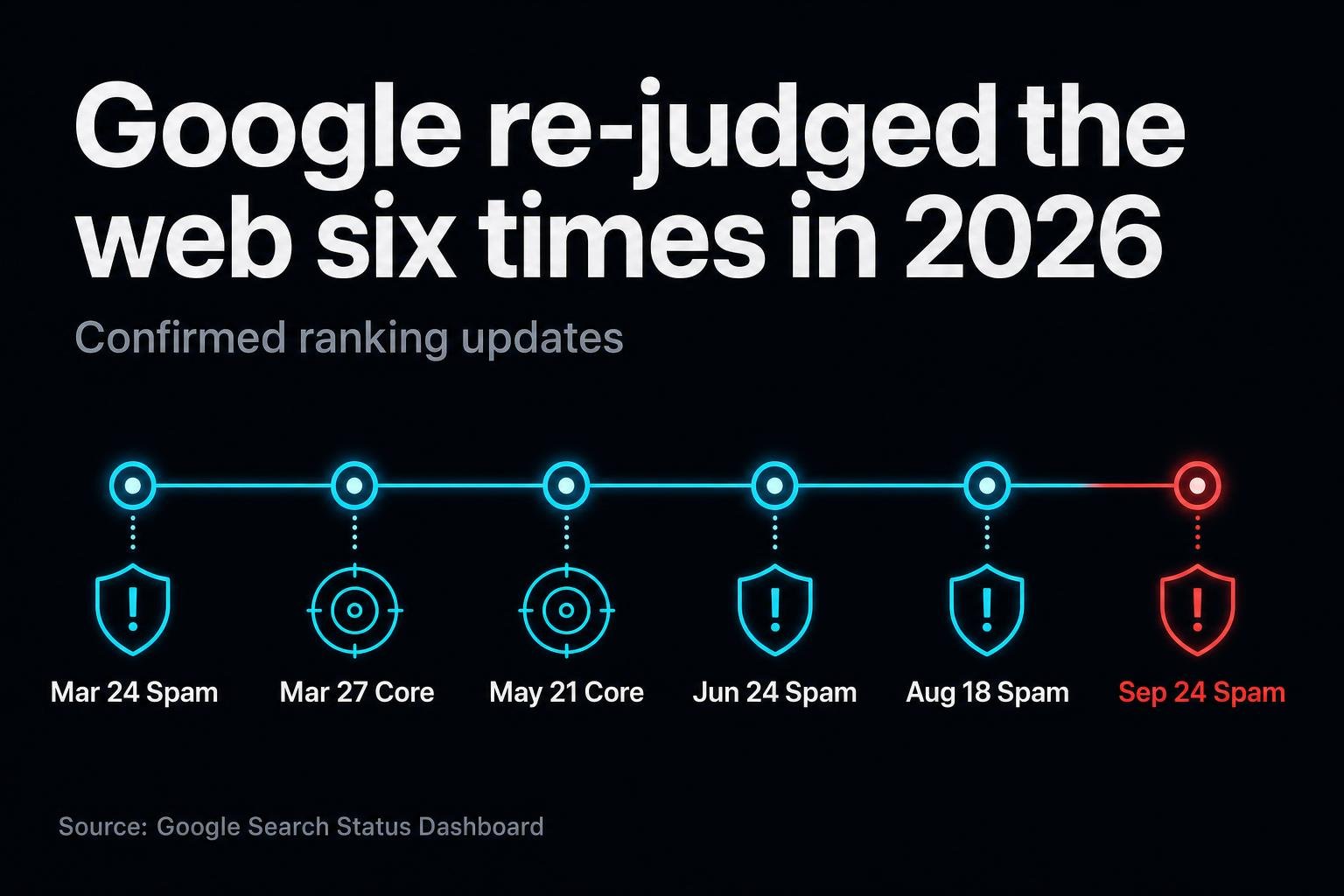
Google keeps a public list of its confirmed ranking updates. This year it reads like a drumbeat:
- March 24: spam update
- March 27: core update
- May 21: core update
- June 24: spam update
- August 18: spam update
- September 24: spam update. It took 13 days and 16 hours to finish, on October 8.
Lily Ray pointed out that Google ran four spam updates in 2026 and only one in 2025, and that the gaps between them keep shrinking: 92 days, then 55, then 37. The September update was also the slowest by far. The other three spam updates this year each finished in under three days.
What did it target? Google didn't say. Barry Schwartz tracked the impact in waves: September 25 to 27, September 30, and October 4 to 6. Even measuring the damage was hard. Nozzle, a rank-tracking company, found that 8% of the results pages Google served to rank-tracking tools had their results quietly swapped out. Lily Ray shared a site whose owner confirmed a heavy drop on September 29 that one major SEO tool still wasn't showing. A lot of business owners were trying to understand what happened from charts that weren't telling them the truth.
Why it happens
I think about it like a city with one landlord. Almost every shop rents from him, and he rewrites the lease several times a year without saying which clause changed.
1. There is one gatekeeper. Google handled 89.94% of the world's searches in September 2026, according to StatCounter. Bing had 5.29%. If your customers find you through search, you have one supplier of customers. That isn't a channel, it's a dependency.
2. Rankings are a curve, not a pass mark. Google's own guidance on core updates says a drop doesn't mean something is wrong with your page. Other pages may simply be judged more useful now. Its analogy is a list of the best restaurants: you didn't get worse, other restaurants moved into your spot.
There are only ten places on the first page, so when Google decides to reward a different kind of result, everyone else slides. In 2024, Reddit's traffic grew 39% in a year (Similarweb, via Search Engine Journal) as Google showed more forum results. Google denied that its data deal with Reddit had anything to do with it. In the May 2026 core update the tide turned the other way. Aleyda Solis found forum and Q&A visibility fell 24% in the UK and 12% in the US.
3. A machine grades the whole site, not one page. Spam updates are improvements to Google's automated spam detection. Google says it finds violations through automated systems and, where needed, human review. Sites that break its policies can rank lower or disappear from results entirely. That makes one corner of a site enough to drag down the rest. Three common examples map straight onto Google's written policies:
- Location pages that only swap the town name. Google's spam policy lists pages aimed at particular regions or cities that funnel visitors to one page as doorway abuse.
- Links bought to boost rankings. That's link spam.
- Large batches of AI-written pages that add nothing. That can count as scaled content abuse.
4. Google keeps redrawing the line on mass-produced content. In March 2024 Google introduced new spam policies for mass-produced content, for exploiting another site's reputation and for abusing expired domains. It later said results showed 45% less low-quality, unoriginal content. Its guidance on AI content, last updated October 1, 2026, says all AI-generated content should be fact-checked by a person before publishing. It also says that generating many pages without adding value can break the scaled content policy.
What gets hit is not a mystery after the fact. Glenn Gabe documented a site that lost rankings for more than 200,000 queries in the August 2026 spam update. It combined programmatic pages across countries with fully AI-generated content. What is a mystery is where Google moved the line this time, because it doesn't publish that.
5. No explanation, no appeal, and recovery takes months.
- No explanation: Google rarely says what an update targeted.
- No appeal: Google's manual penalties come with a reconsideration request once you fix the problem. Its help pages describe no equivalent review for automated demotions.
- Months to recover: after a spam update, Google says things improve only once its systems learn, over a period of months, that the site follows its spam policies.
- Bought links are gone for good: if links were the problem, Google says any ranking benefit they brought cannot be regained.
- Core updates are slower still: recovery can take several months, and sometimes means waiting for the next core update.
Months is a long time for any business that lives on search.
6. Google keeps more of the click for itself. This one hits businesses that never get penalised:
- Pew Research: people clicked a traditional result on 8% of visits when an AI summary appeared, against 15% when none did. They clicked a link inside the summary on 1% of visits.
- Ahrefs: on searches with an AI Overview, the top result's click rate fell from 7.3% to 1.6% between December 2023 and December 2025.
- SparkToro: 68.01% of Google searches in the first four months of 2026 ended without a click.
So even a full recovery brings you back to a smaller pie.
What it has done to real businesses
These are the companies' own explanations, so read them as their side of the story. The pattern is still hard to ignore.
- HouseFresh, a small independent product review site, lost 91% of its Google traffic after the March 2024 core update, according to Search Engine Land.
- Retro Dodo, an independent retro gaming site, wrote that Google had cut its organic traffic and revenue by 85% since September 2023, and that it was out of cash.
- Giant Freakin Robot went from more than 20 million monthly readers to a few thousand, and announced in November 2024 that it was shutting down its website.
- Chegg cut 388 jobs, about 45% of its workforce, in November 2025, after suing Google over AI Overviews earlier that year.
- Business Insider laid off 21% of its staff in 2025, citing AI disruption and extreme traffic drops.
- The Washington Post laid off roughly a third of its staff on February 4, 2026, more than 300 of them from an 800-person newsroom. Its executive editor said organic search had fallen by nearly half over three years.
- Reach, the UK publisher of the Mirror and the Express, reported Google referral traffic down 55% in its July 2026 results. It later cut 220 editorial jobs.
- People Inc, formerly Dotdash Meredith, said Google search went from about 70% of its traffic five years ago to about 30%.
- Tripadvisor's CEO told investors in February 2026 that it was seeing ongoing declines in casual visitors because of AI Overviews. Its CFO expects search to drive under 10% of its Experiences bookings by the end of 2026.
- Tour operators: across 275+ tour and activity operators, organic search sessions fell about 26% from 2024 to 2025, according to TOMIS, a booking software company.
The smallest players get hit hardest. Chartbeat found that over two years, search referrals fell 60% for small publishers, 47% for mid-sized ones and 22% for large ones. When rankings are a curve, the biggest brands sit on the safe end of it.
And the courts are not coming to the rescue. On October 1, 2026, Press Gazette reported that a US judge had dismissed Penske Media's antitrust lawsuit over AI Overviews, and Chegg's similar case. Regulators are moving, slowly:
- UK: in June 2026 the competition regulator ruled that publishers will be able to opt out of their content being used for Google's AI search features.
- EU: the European Commission opened a formal antitrust investigation in December 2025.
Neither brings back a lost quarter.
Why AI visibility matters most now
Buyers no longer only scan ten blue links. More and more, they ask a question and get an answer, and that answer names a handful of businesses.
The audience is already there.
- ChatGPT reaches 1.2 billion people a week, by OpenAI's own figure.
- Google says AI Overviews has more than 2.5 billion monthly users and AI Mode more than 1 billion.
- Pew found in 2026 that 42% of American adults have used AI chatbots to search for information.
The answer names only a few businesses.
- BrightEdge found ChatGPT mentions 2.4 brands per prompt on average, and 44% of prompts name none at all.
- A panel of real AI conversations by Murmuras found a median of three brands when brands came up.
- If you aren't one of those few, that buyer never hears your name. Being named is the new page one.
The engines don't simply copy Google's rankings.
- A 2025 Ahrefs study of 15,000 queries found that only about 12% of the URLs cited by AI assistants ranked in Google's top 10 for the same question.
- In March 2026 Ahrefs found that even Google's AI Overviews drew only about 38% of their citations from Google's top 10, down from about 76% in mid-2025. Part of that drop comes from a change in how Ahrefs measures.
- Separately, Ahrefs found that how often a brand is mentioned across the web correlates with AI Overview visibility far more strongly than its backlinks do: 0.664 against 0.218. That's a correlation, not proof of cause, but it points away from the old link-building playbook.
I tested it on the yacht case. On October 16, 2026, I asked ChatGPT, Perplexity and Gemini the same four questions about chartering a yacht in Singapore, twice each. That's a small test, and AI answers vary from run to run, but the pattern was clear:
- ChatGPT: The charter companies' own websites. About four in five of the sources it cited were operator sites, led by Yachtly (6 of 8 answers) and White Sails (4 of 8).
- Perplexity: A wider mix. Fun Empire (7 of 8 answers), Tripadvisor, BestThingReview, Sassy Mama, Trip.com and Klook, alongside the operators.
- Gemini: Searches Google and leaned on Singapore lifestyle media: Honeycombers (7 of 8), Sassy Mama (5), Seth Lui (5), Time Out (3), alongside operators.
Three engines, three different kinds of sources. A business whose own website clearly explains what it offers can be named by ChatGPT. A business that only exists in its own Google ranking has nothing to fall back on when that ranking goes.
The honest part most posts leave out
AI visibility is not an escape hatch from Google, and anyone who sells it that way is setting you up.
Google's AI is still Google. AI Overviews and AI Mode only use pages that are in Google's index and eligible to show in its results, and in my test Gemini answered by searching Google. Glenn Gabe has documented that "if you drop in Google, you can drop heavily in AI Search platforms." Google's own guide says optimising for its AI search features is still SEO. Mike King calls that guidance naive and self-serving. He argues AI answers depend on your presence in places like Wikipedia, Reddit and third-party publications, which on-page work doesn't touch.
AI traffic is still small. Ahrefs measured all AI chatbots combined at 0.28% of web traffic in March 2026. Conductor's benchmark of 13,770 domains put AI referrals at 1.08%. Adobe reports that AI visitors to US retail sites converted 42% better than other visitors in March 2026, but that's a vendor's figure. The case for AI visibility today is about being named in the answer, not about AI clicks replacing Google tomorrow.
The answers wobble. SparkToro found less than a 1 in 100 chance that ChatGPT or Google's AI gives the same list of brands in two responses. So nobody can honestly promise you "#1 in ChatGPT." What you can measure is how often you get named across many runs.
The predictions overshot. In 2024 Gartner predicted search engine volume would drop 25% by 2026 because of AI chatbots. In April 2026 Google said its queries were at an all-time high. Searching didn't collapse. Clicking did.
What I take from all this
The question isn't "how do I recover from the September update." It's "how many judges know my name."
A business that lives on Google rankings alone has one landlord and no lease. A business that AI engines can describe accurately, that other sites mention, and that gets named when a buyer asks ChatGPT, Perplexity or Gemini has more than one way to be found. Google can still hurt it. Google is no longer the only door.
So I'd do three things:
- Be the clearest source on the internet about what you do, who it's for and what it costs.
- Get mentioned in the places these engines read, not only the places Google ranks.
- Measure how often each engine names you, the way you used to track your Google position, because a number you can see beats a chart you can't trust.
One signal a day. No noise.
A 3-minute read when something genuinely shifts in AI, automation, or defense tech. Free, most weekdays.
Free, most weekdays. No spam, unsubscribe anytime.Sources
- Google Search Status Dashboard, ranking update history - https://status.search.google.com/products/rGHU1u87FJnkP6W2GwMi/history
- Google: spam updates and your site - https://developers.google.com/search/updates/spam-updates
- Google: core updates and your site - https://developers.google.com/search/updates/core-updates
- Google: spam policies - https://developers.google.com/search/docs/essentials/spam-policies
- Google: manual actions report - https://support.google.com/webmasters/answer/9044175
- Google: using generative AI content - https://developers.google.com/search/docs/fundamentals/using-gen-ai-content
- Google: March 2024 search update and new spam policies - https://blog.google/products/search/google-search-update-march-2024/
- Google: AI features and your website - https://developers.google.com/search/docs/appearance/ai-features
- Google: AI optimization guide - https://developers.google.com/search/docs/fundamentals/ai-optimization-guide
- Google I/O 2026 keynote - https://blog.google/innovation-and-ai/sundar-pichai-io-2026/
- Alphabet Q1 2026 earnings remarks - https://blog.google/company-news/inside-google/message-ceo/alphabet-earnings-q1-2026/
- Search Engine Journal: September 2026 spam update complete - https://www.searchenginejournal.com/google-september-2026-spam-update-complete/592283/
- Search Engine Roundtable: September 2026 spam update done - https://www.seroundtable.com/google-september-2026-spam-update-done-42235.html
- Search Engine Roundtable: third-party rank tracking broken - https://www.seroundtable.com/third-party-google-rank-tracking-broken-42272.html
- Diib: September 2026 spam update early data - https://diib.com/start/insights/google-september-2026-spam-update-early-data/
- Lily Ray: prediction, the next massive Google update - https://lilyraynyc.substack.com/p/prediction-the-next-massive-google
- Glenn Gabe: August 2026 spam update case studies - https://www.gsqi.com/marketing-blog/august-2026-google-spam-update-case-studies/
- Glenn Gabe: May 2026 core update analysis - https://www.gsqi.com/marketing-blog/core-roars-back-google-may-2026-core-update-analysis/
- Aleyda Solis: May 2026 core update analysis - https://www.aleydasolis.com/en/ai-search/google-may-2026-core-update-analysis-intent-market-fit-and-source-type-drove-the-biggest-visibility-shifts/
- Search Engine Journal: Reddit traffic up 39% - https://searchenginejournal.com/reddit-traffic-up-39-is-google-prioritizing-opinions-over-expertise/520219
- r/SEO: 95% Google traffic loss in one day during the September 2026 spam update - https://www.reddit.com/r/SEO/comments/1wtnj5t/sudden_95_google_search_traffic_loss_in_1_day/
- StatCounter: search engine market share - https://gs.statcounter.com/search-engine-market-share
- Search Engine Land: HouseFresh lost 91% of its Google traffic - https://searchengineland.com/review-site-google-traffic-affiliate-seo-content-440143
- Retro Dodo: Google is killing Retro Dodo - https://retrododo.com/google-is-killing-retro-dodo/
- Nieman Lab: Giant Freakin Robot - https://www.niemanlab.org/reading/how-googles-algorithm-shifts-have-strangled-one-independent-news-site/
- Hello Partner: Giant Freakin Robot shuts down - https://hellopartner.com/2024/11/05/news-outlet-giant-freakin-robot-shuts-down-amidst-google-troubles
- K-12 Dive: Chegg cuts 388 jobs - https://www.k12dive.com/news/chegg-layoffs-strategic-alternatives-google-ai/804568/
- Nieman Lab: Business Insider lays off 21% of staff - https://www.niemanlab.org/2025/05/business-insider-will-lay-off-21-of-staff-amid-ai-disruption-and-extreme-traffic-drops-outside-of-our-control/
- Poynter: Washington Post layoffs - https://www.poynter.org/business-work/2026/washington-post-layoffs-sports-books-metro/
- Press Gazette: Reach H1 2026 results - https://pressgazette.co.uk/news/reach-moves-away-from-volume-as-traffic-revenue-and-share-price-plunge/
- TNW: Reach cuts 220 editorial jobs - https://thenextweb.com/news/reach-cuts-220-editorial-jobs
- AdExchanger: People Inc and Google - https://www.adexchanger.com/publishers/people-inc-says-who-needs-google/
- Skift: Tripadvisor sees traffic decline from AI Overviews - https://skift.com/2026/02/12/tripadvisor-sees-traffic-decline-from-ai-overviews-considers-strategic-alternatives-again/
- TOMIS: the traffic paradox for tour operators - https://tomis.tech/blog/the-traffic-paradox-how-tour-operators-are-booking-more-trips-with-fewer-website-visitors/
- Axios: Chartbeat search referral data - https://www.axios.com/2026/03/17/chartbeat-search-traffic-ai-chatbots
- Press Gazette: Penske AI Overviews lawsuit dismissed - https://pressgazette.co.uk/news/penske-ai-overviews-lawsuit-dismissed-because-no-formal-bargain-struck-with-google/
- UK CMA: publishers can opt out of Google's AI features - https://www.gov.uk/government/news/cma-secures-fairer-deal-for-publishers-and-improves-google-search-services-in-uk
- SCL: European Commission investigates Google over online content for AI - https://www.scl.org/european-commission-investigates-google-for-using-online-content-for-ai-purposes/
- Pew Research: Google users click less with AI summaries (2025) - https://www.pewresearch.org/short-reads/2025/07/22/google-users-are-less-likely-to-click-on-links-when-an-ai-summary-appears-in-the-results/
- Pew Research: Americans and AI (2026) - https://www.pewresearch.org/internet/2026/06/17/americans-and-ai-2026-chatbots-smart-devices-and-views-on-impact/
- Ahrefs: AI Overviews reduce clicks - https://ahrefs.com/blog/ai-overviews-reduce-clicks-update/
- SparkToro: less than one third of Google searches still send a click - https://sparktoro.com/blog/in-2026-less-than-one-third-of-google-searches-still-send-a-click/
- OpenAI: ChatGPT reaches 1.2 billion people each week - https://openai.com/index/new-chatgpt-ads-format-and-measurement/
- BrightEdge: ChatGPT brand mentions - https://www.brightedge.com/resources/weekly-ai-search-insights/chatgpt-brand-mentions-vs-citations-what-triggers-visibility
- Murmuras: brand visibility in ChatGPT and Gemini - https://murmuras.com/en/blog/brand-visibility-chatgpt-gemini
- Ahrefs: only 12% of AI-cited URLs rank in Google's top 10 - https://ahrefs.com/blog/ai-search-overlap/
- Ahrefs: AI Overview citations and the top 10 - https://ahrefs.com/blog/ai-overview-citations-top-10/
- Ahrefs: brand mentions and AI Overview visibility - https://ahrefs.com/blog/ai-overview-brand-correlation/
- Ahrefs: AI chatbot traffic share - https://ahrefs.com/blog/ai-chatbot-traffic/
- Conductor: AEO and GEO benchmarks - https://conductor.com/academy/aeo-geo-benchmarks-report/
- TechCrunch: AI traffic to US retailers (Adobe data) - https://techcrunch.com/2026/04/16/ai-traffic-to-us-retailers-rose-393-in-q1-and-its-boosting-their-revenue-too/
- SparkToro: AIs are inconsistent when recommending brands - https://sparktoro.com/blog/new-research-ais-are-highly-inconsistent-when-recommending-brands-or-products-marketers-should-take-care-when-tracking-ai-visibility/
- iPullRank: Google's guidance on AI search - https://ipullrank.com/google-ai-search-guidance
- Gartner: search engine volume prediction (2024) - https://www.gartner.com/en/newsroom/press-releases/2024-02-19-gartner-predicts-search-engine-volume-will-drop-25-percent-by-2026-due-to-ai-chatbots-and-other-virtual-agents
Quick answers
What did Google's September 2026 spam update target?
Google didn't say. It ran from September 24 to October 8, 2026. SEO analysts tracked impact in waves on September 25 to 27, September 30 and October 4 to 6, and Lily Ray reported templated, programmatic pages among those hit. That's their analysis, not Google's statement.
How long does it take to recover from a Google spam update?
Google says things improve only after its systems learn over a period of months that a site follows its spam policies. If the problem was links bought to manipulate rankings, Google says that ranking benefit can't be regained.
Does AI visibility protect a business from Google updates?
Partly. Studies find AI assistants cite many pages that don't rank in Google's top 10, so they spread the risk. But Google's AI Overviews and AI Mode use Google's index, so a Google demotion can hurt there too.
Is AI search traffic big enough to matter yet?
As clicks, not yet. Ahrefs measured 0.28% of web traffic in March 2026, and Conductor's benchmark put it at about 1%. But ChatGPT reaches 1.2 billion people a week and answers name only a few brands, so being named matters more than the click count suggests.