Cold Email's Rulebook Just Changed
DMARC quietly rewrote its tags this month and Google is making deliverability legible in plain English. Here is what actually moved, and the numbers that now decide whether your email lands.

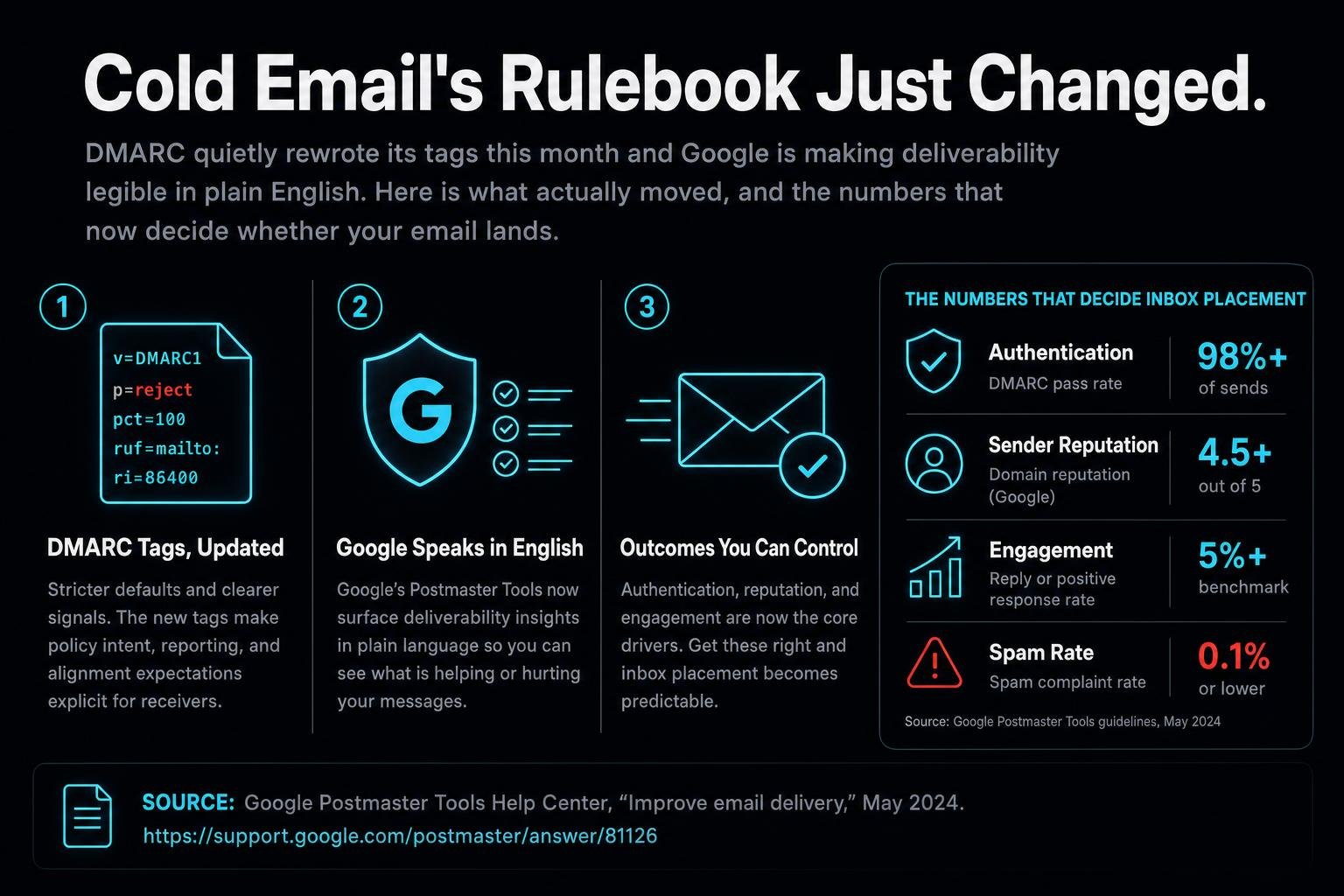
Most people think email either sends or it doesn't. The truth is messier. Every message you send goes through a quiet bouncer at the door of the inbox, and in June 2026 that bouncer got a new rulebook. If you do any kind of outbound, whether that's a recruiter reaching out, a founder pitching, or a marketer running sequences, the changes this month decide whether you land in the inbox or the void of spam.
Here is the plain-language version of what changed and why it matters, without the acronym soup.
The rules that just moved
The backbone of email trust is a standard called DMARC. Think of it as the ID check that tells Google and Outlook, yes, this email really came from who it claims to be. This month DMARC added two new instructions and quietly retired two old ones.
- A new np tag tells receivers how to treat mail claiming to come from a subdomain that doesn't actually exist. This is the one to care about. A misconfigured subdomain policy is one of the silent killers of deliverability, and now there's a specific lever for it.
- A new T testing tag lets you trial settings before enforcing them, so you can see what would happen without blowing up your live mail.
- The main p= policy, which used to be effectively mandatory, is now recommended rather than strictly required. A subtle shift, but it changes how strictly you need to configure.
At the same time, Google is adding a deliverability-analysis layer to its Postmaster Tools that gives plain-language recommendations instead of raw, cryptic numbers. That last part is bigger than it sounds.
Imagine your car's engine light finally explained itself in a full sentence instead of a single orange icon. For years, deliverability was a dark art understood by a handful of specialists squinting at DNS records. Now the diagnosis is becoming readable by anyone. That means problems get exposed, but it also means anyone can finally see and fix them.
The numbers that decide the door
The math behind the bouncer hardened too, and the figures are blunt. According to the 2026 benchmark data, fully authenticated domains (the ones with all three checks, SPF, DKIM, and DMARC, properly set) land in the inbox 2.7 times more often than unauthenticated ones.
That is not a rounding error. That is the difference between a campaign that works and one that quietly dies. The rest of the thresholds are equally unforgiving:
- Bounce rate must stay under 3%.
- Spam complaints must stay under 0.3%. That's three complaints per thousand sends.
- Average reply rate sits at just 3.43%, with top performers clearing 10%+.
Read those last two together and a picture emerges. The average sender gets a reply from roughly one in thirty emails. The best get one in ten. The gap between them is almost never the cleverness of the copy. It's whether the message arrived at all.
Authentication isn't the polish on a campaign. It's the floor. Without it, your best writing never gets read because it never gets delivered.
From volume to intent
The strategic consensus for 2026 is a real shift: away from blasting volume and toward intent-led precision. For a decade the outbound playbook was a numbers game. Send enough and some stick. That era is closing.
The new gatekeeping math punishes spray-and-pray directly. High volume to uninterested people drives up bounces and complaints, which drags down your sender reputation, which drops you into spam, which makes the next send worse. It's a doom loop. The only escape is sending fewer, more relevant messages to people who might actually want them. The infrastructure is now quietly enforcing what good marketers always knew.
What this means for you
You don't need to be a deliverability engineer to act on this. A few honest takeaways:
- Authentication is non-negotiable. If SPF, DKIM, and DMARC aren't all properly set on your sending domain, you are starting the race 2.7x behind. Fix that before you touch the copy.
- Mind your subdomains. The new np tag exists because subdomain misconfiguration is a common and invisible failure. If you send from one, check it.
- Watch your complaint rate like a hawk. The 0.3% ceiling is brutal. One bad list or one irrelevant blast can sink you for weeks.
- Treat Postmaster's new feedback as free advice. Plain-language recommendations from the platform itself are the cheapest deliverability consultant you'll ever get.
The deeper point is that email is getting more honest. The systems are converging on a simple principle: prove who you are, and only send to people who want to hear from you. That's not a constraint to resent. It's the inbox finally rewarding the people who were doing it right all along.
One signal a day. No noise.
A 3-minute read when something genuinely shifts in AI, automation, or defense tech. Free, most weekdays.
Free, most weekdays. No spam, unsubscribe anytime.Sources
- UnifyGTM - Cold Email 2026: Domain Setup, Deliverability & Sequences - https://www.unifygtm.com/explore/cold-email-2026-domain-setup-deliverability-sequences
- Saleshandy - Email Deliverability Statistics (53M-email study) - https://www.saleshandy.com/blog/email-deliverability-statistics/
- Instantly - Cold Email Benchmark Report 2026 - https://instantly.ai/cold-email-benchmark-report-2026
Quick answers
What changed with DMARC in June 2026?
DMARC added a new 'np' tag for handling mail from non-existent subdomains and a 'T' testing tag, while the main 'p=' policy shifted from mandatory to recommended. Google also began rolling out plain-language deliverability feedback in Postmaster Tools.
Does email authentication really affect deliverability that much?
Yes. Fully authenticated domains using SPF, DKIM, and DMARC land in the inbox 2.7 times more often than unauthenticated domains, according to 2026 benchmark data.
What are the deliverability thresholds I should not cross?
Keep bounce rate under 3% and spam complaints under 0.3%. The average reply rate for cold outbound is 3.43%, with top performers exceeding 10%.
Is high-volume cold email still effective in 2026?
Less so. The strategic shift is from volume to intent-led precision, because high volume to uninterested recipients raises bounces and complaints that damage sender reputation and hurt future deliverability.