The Platform Is Rewriting Your Headline
Meta's Advantage+ has been editing the text baked into advertisers' images since late July, and its first in-house image model is about to make that editing smarter. The interesting part isn't that ads get generated. It's that they get quietly changed.

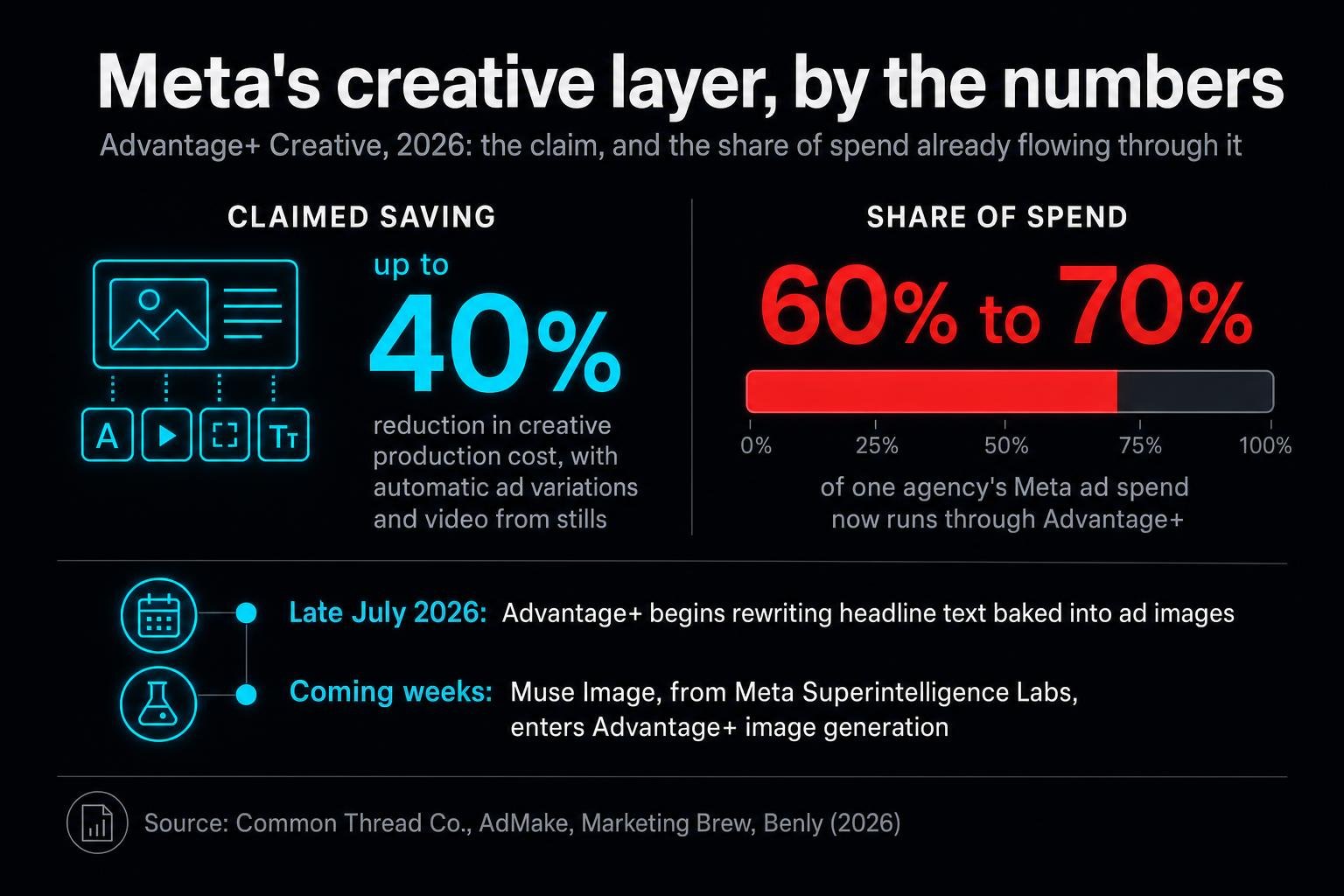
Late in July, without much noise, Meta started rewriting words baked into advertisers' images. Not the headline field you type into the form. The text inside the picture, the part you thought was a flat file you controlled.
That was the warm up. Meta has now introduced Muse Image, the first image generation model out of Meta Superintelligence Labs, into Advantage+ creative image generation. It rolls out to advertisers and agencies "in the coming weeks."
Editing is a bigger deal than generating
For two years the story about AI creative has been generation: describe a thing, receive a thing. That story is easy to reason about, because a generated ad looks generated. You notice.
Muse Image is pitched differently. It parses a creative brief, then adjusts individual elements, swaps styles, and produces on brand variations instead of regenerating from scratch. Meta describes it in terms of agentic reasoning and iterative refinement, which is a technical way of saying it behaves less like an artist and more like a retoucher.
Think of a print shop. A shop that throws out your poster and prints a new one from its own design is obvious the moment you walk past the wall. A shop that retypes one line, nudges the product left, warms the background, and rehangs it is invisible unless you brought the original with you and held it up side by side.
A platform that regenerates your creative is easy to catch. A platform that edits it is not.
The 40 percent claim, and what it moves
Advantage+ Creative now also generates video from static images and produces multiple ad variations automatically, with a claimed reduction in creative production cost of up to 40 percent. Vendor numbers deserve a discount, so assume half of it. Half is still enormous.
Because if creative production gets meaningfully cheaper, volume stops being the bottleneck on testing, and the scarce input moves. It moves to angle and offer: which promise you make, to whom, against which objection. That is judgment work. A model can render forty variants of a claim it was handed. It cannot decide which claim is worth making, or which one your legal review will survive.
And this is not a side experiment running in a lab tab. One agency reports Advantage+ now accounts for 60 to 70 percent of its Meta spend. The automated path is already the main road.
Where it gets uncomfortable
Now put those two facts together. On image text can be rewritten, and the new model refines rather than replaces. That means the gap between the asset you uploaded and the asset that served can be small. Small enough that nobody catches it in a weekly performance review, where everyone is looking at cost per result and nobody is reading the picture.
For a generic ecommerce brand, that is a rounding error in brand consistency. For anything with claim sensitive copy, health, supplements, finance, legal, anything where a specific sentence was approved by a specific person for a specific reason, an ad platform that silently edits copy is not a convenience feature. It is exposure.
As it stands, the controls are coarse. There is no fine grained switch that disables on image text rewriting while leaving the rest of Advantage+ creative intact, which puts regulated categories in an ugly spot: turn off a genuine performance feature wholesale, or accept edits you did not review.
The quieter change underneath
Two other 2026 shifts are landing in the same season. Attribution narrowed: click through is now limited to link clicks, with other interactions moved to engage through. And Andromeda, Meta's personalized ads retrieval system, is rolling out more widely.
So the creative is changing, the delivery is changing, and the measuring stick is changing, all at once. Anyone comparing this quarter to last year without noting that is comparing two different instruments.
What this actually asks of you
Three things, none of them exotic.
- Decide your toggles on purpose. Write down, in one paragraph, whether Advantage+ text and image generation is enabled on campaigns where the exact wording matters. A default you never chose is still a choice, it just has no author.
- Diff your creative. Keep a record of what you uploaded and check it against what actually served, on a schedule. Drift found in days is a note. Drift found at audit is an incident.
- Change the unit you sell and report. If assets are getting cheap, stop counting assets. Count hypotheses tested. That is where the value went.
The honest read
I am not gloomy about this. I have watched too many good ideas die because producing the twelfth variation was too expensive to bother, and Muse Image plus automatic variations plus video from stills genuinely kills that excuse.
But notice the trade being offered. The platform is getting very good at making the thing, and it is quietly taking custody of what the thing says. The first half is a gift. The second half is only a gift if you were never going to read your own ads anyway.
One signal a day. No noise.
A 3-minute read when something genuinely shifts in AI, automation, or defense tech. Free, most weekdays.
Free, most weekdays. No spam, unsubscribe anytime.Sources
- Common Thread Co.: Meta ads changes 2026 changelog - https://commonthreadco.com/blogs/coachs-corner/meta-ads-changes-2026
- AdMake: Meta ads updates, August 2026 - https://admakeai.com/blog/meta-ads-updates-august-2026
- Marketing Brew: Meta AI ad creation - https://www.marketingbrew.com/stories/2026/04/07/meta-ai-ad-creation
- Benly: Advantage+ updates 2026 - https://benly.ai/learn/meta-ads/advantage-plus-updates-2026
Quick answers
What is Meta's Muse Image?
Muse Image is the first image generation model out of Meta Superintelligence Labs. Meta is introducing it into Advantage+ creative image generation, rolling out to advertisers and agencies in the coming weeks. It is pitched around agentic reasoning and iterative refinement: it parses a creative brief, then adjusts individual elements, swaps styles, and produces on brand variations rather than regenerating an image from scratch.
Is Meta already changing advertisers' ad images?
Yes. Since late July, Advantage+ has been rewriting headline text baked into ad images. That is separate from, and earlier than, the Muse Image rollout.
How much does Advantage+ claim to cut creative costs?
Meta claims a reduction in creative production cost of up to 40 percent, alongside features that generate video from static images and produce multiple ad variations automatically. For scale of adoption, one agency reports Advantage+ now accounts for 60 to 70 percent of its Meta spend.
What changed with Meta ads attribution in 2026?
Click through attribution is now limited to link clicks, with other interactions moved to engage through. Meta is also rolling out Andromeda, its personalized ads retrieval system, more widely. Both changes land in the same period as the creative changes, so year over year comparisons need that context.