On 15 September, Ads Become a Bot Bouncer
On 15 September 2026, Cloudflare starts blocking AI training and agent crawlers by default on any page that carries ads. The tripwire is small. The consequences are not.

Six days from now, a large slice of the internet quietly changes its mind about who is allowed to read it.
On 15 September 2026, Cloudflare flips the default bot policy for all new sites and all of its existing free-tier customers. Training crawlers and agent crawlers get blocked on any page that hosts ads. Not blocked because a site owner went looking for the setting and turned it on. Blocked because that is now what arrives out of the box.
The tripwire is an ad tag
Cloudflare's logic is worth sitting with, because it is genuinely clever. An ad on a page is evidence that the owner intended a human being to land there. So a bot that shows up, takes the content, and displaces that human gets kept outside.
Think of a coffee shop with a menu board and a tip jar. The tip jar is proof the room was built for people. It is not there for a machine that photographs the menu, never orders, and leaves. Cloudflare has decided the ad tag is the tip jar.
Bots now have job titles, not species
The deeper change is a reclassification. Cloudflare stopped sorting crawlers into "AI" and "not AI" and started sorting them by function: Search, Agent, Training. It is also extending the Content Signals format in robots.txt with a new use parameter, so a site can declare those preferences out loud instead of hoping.
That split matters because those three jobs were never the same deal:
- Search is the old bargain. Index me, send me people.
- Agent is the errand runner. Someone asked an assistant a question right now, and it is fetching your page to answer it.
- Training is the vacuum cleaner. Your writing gets absorbed into a model, permanently, credit optional.
Until now the web had one switch covering all three. If you hated being training data, your only real move was to slam the door on everything. Function-level classification is the first time a site owner can say yes to the errand runner and no to the vacuum cleaner.
For thirty years the web had exactly one answer for robots: yes or no. It now has three separate questions, and most site owners have never been asked any of them.
The trap buried in the fine print
Here is the part that will hurt people. Multi-purpose crawlers get the most restrictive rule that applies. Cloudflare explicitly names Googlebot, Applebot and Bingbot as crawlers that will be blocked for any customer who chose to block Training.
Read that again slowly. A well-meaning "block AI training" toggle, flipped by a well-meaning developer on a Tuesday afternoon, can take you out of classic search.
It is a bouncer who has been told "no photographers" and turns away the guy who is both a photographer and the person delivering the beer. Technically correct. Commercially catastrophic.
Why silence is the dangerous part
Nothing rings. No alarm fires, no email arrives, no dashboard turns red. You find out weeks later, when your traffic or your citations have already drifted.
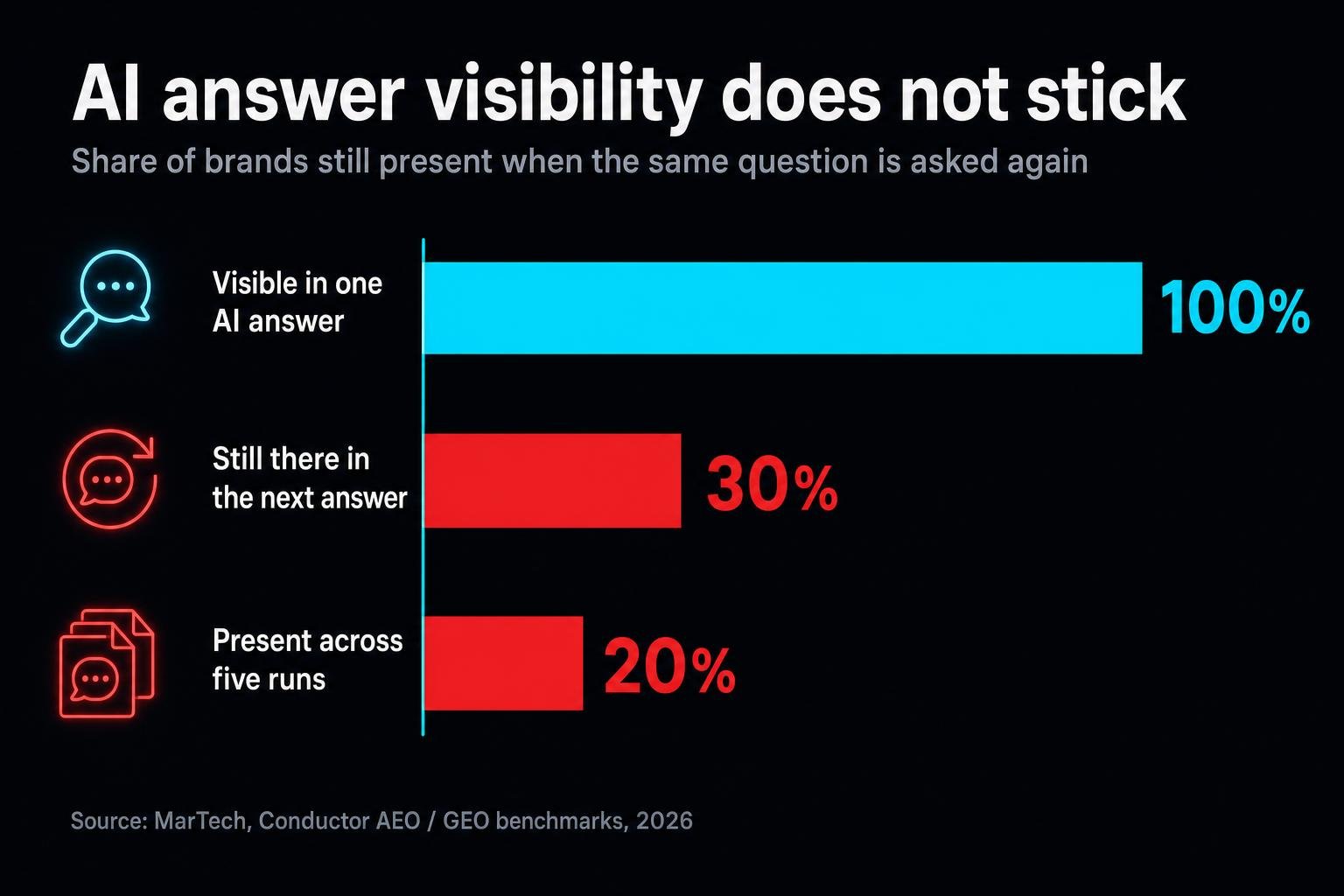
And the drift is brutal even when nothing is broken. Recent benchmarks found that only 30% of brands stay visible from one AI answer to the next, and just 20% remain present across five consecutive runs. Ask the same assistant the same question five times and four out of five brands vanish somewhere along the way.
That is the real problem with an accidental block. It looks exactly like the noise. You are trying to spot a leak while standing in a river.
Compliance gets a scoreboard
The other half of the announcement is enforcement. Cloudflare says it will publish, via BotBase, whether Verified Bots actually honour the preferences sites declare. Bots that ignore those preferences, or that reproduce content in full, can lose Verified status.
This is the genuinely new thing. robots.txt has always been a sign on a door, never a lock. Politeness with no consequence. Attaching a public record and a revocable badge to it is the first time in years that the sign has had teeth.
What this means if you run a website
Not a strategy. Just the short list of things that are now true:
- Your plan tier decides your defaults. New sites and free-tier customers inherit the new policy.
- Whether a page carries ad tags decides whether it is in scope. That makes your ad inventory a crawler-policy question, which nobody expected.
- "Block AI" is no longer one decision. It is three, and they point in different directions for most businesses.
- Declaring your preference on purpose beats inheriting one you never chose.
- Whatever you decide, write down why, because the next person to touch the config will otherwise undo it in good faith.
The bigger story
Strip away the mechanics and this is one instance of a much larger shift: the free, ambient distribution channels of the internet are being metered.
The original deal was simple. You publish, you get crawled, you get traffic. Assistants broke the second half of that sentence. They read everything and send back almost nothing, and publishers noticed.
Cloudflare sits in front of an enormous share of the web, which makes it the first infrastructure player big enough to turn that grievance into a default. Not a lawsuit, not a licensing negotiation, not an open letter. A setting, applied per function, with a public compliance record attached.
You can love that or hate it depending on which side of the crawler you sit on. What you cannot really argue with is the direction. The era where reading the entire web cost nothing and asked no permission is ending, one default at a time.
The date is 15 September. The setting is already written. It is worth knowing which side of it your pages land on.
One signal a day. No noise.
A 3-minute read when something genuinely shifts in AI, automation, or defense tech. Free, most weekdays.
Free, most weekdays. No spam, unsubscribe anytime.Sources
- Chudi.dev - Cloudflare to block AI crawlers on 15 September - https://chudi.dev/blog/cloudflare-block-ai-crawlers-september-15
- Crawl Lab - Cloudflare blocks AI crawlers, September 2026 - https://crawl-lab.com/en/blog/robots-txt/cloudflare-blocks-ai-crawlers-september-2026/
- hosting.com - Cloudflare's new AI crawler defaults and what they mean for site owners - https://hosting.com/blog/cloudflares-new-ai-crawler-defaults-and-what-they-mean-for-site-owners/
- Help Net Security - Cloudflare AI crawler controls - https://www.helpnetsecurity.com/2026/07/02/cloudflare-ai-crawler-controls/
- Technology.org - Cloudflare blocks mixed-use AI crawlers - https://www.technology.org/2026/07/03/cloudflare-blocks-mixed-use-ai-crawlers/
- TechCrunch - Cloudflare's new policy pushes AI companies to pay for publishers' content - https://techcrunch.com/2026/07/01/cloudflares-new-policy-pushes-ai-companies-to-pay-for-publishers-content/
- MarTech - The competition for brand visibility has moved to AI search - https://martech.org/the-competition-for-brand-visibility-has-moved-to-ai-search/
- Conductor - AEO and GEO benchmarks report - https://www.conductor.com/academy/aeo-geo-benchmarks-report/
Quick answers
What actually changes on 15 September 2026?
Cloudflare changes its default bot policy for all new sites and all existing free-tier customers. Training crawlers and agent crawlers get blocked on any page that hosts ads, unless the site owner declares otherwise.
Why do ads decide whether a crawler is blocked?
Cloudflare's stated logic is that an ad on a page is evidence the owner intended a human to land there, so bots that displace that human are the ones kept out.
Could this affect normal Google search?
Yes. Multi-purpose crawlers get the most restrictive rule that applies, and Cloudflare explicitly names Googlebot, Applebot and Bingbot as crawlers that will be blocked for any customer who chose to block Training. A broad "block AI training" choice can take classic search down with it.
How can a site allow some crawlers and refuse others?
Cloudflare now classifies bots by function rather than by whether they are AI, using the categories Search, Agent and Training, and is extending the Content Signals format in robots.txt with a new use parameter so preferences can be declared per function.