Job titles are being sold as software
Optimizely launched AI coworkers named after real marketing roles, and Adobe bought a startup whose product list reads like a sales team. The unit of purchase is changing from a person's month to a role, configured.

Something quietly strange happened in enterprise software this month. Two vendors shipped products that are not named after features. They are named after people's jobs.
The org chart got a price tag
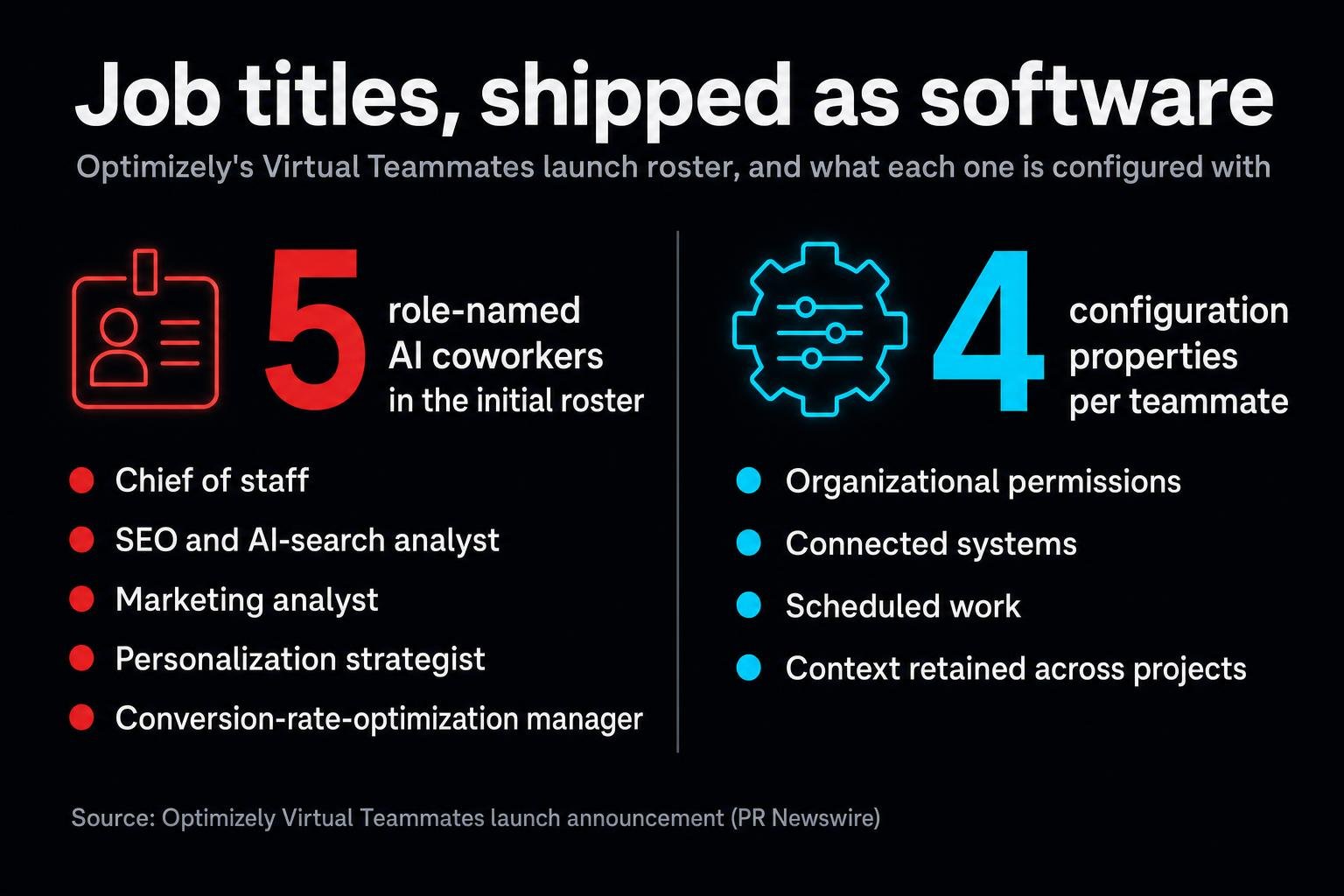
Optimizely launched Virtual Teammates, a suite of role-specific AI coworkers. The initial roster: chief of staff, SEO and AI-search analyst, marketing analyst, personalization strategist, and conversion-rate-optimization manager.
Read that list again. Those are not software categories. Those are lines on a job board. Those are titles that exist on real people's LinkedIn profiles right now, attached to real salaries and real mortgages.
The mechanics matter more than the branding. Each teammate can be configured with organizational permissions, connected to specific systems, given scheduled work, and it keeps context across projects. That is four things at once: an access level, a toolset, a calendar, and a memory. Which is, if you squint, a decent working definition of a colleague.
For three years, AI tools have been sold the way power tools are sold. Here is a very fast drill, go build something. Optimizely is selling something closer to a carpenter: here is a thing with a role, a badge that opens certain doors, a standing Tuesday task, and a memory of what it did last month.
The shift is not that the software got smarter. It is that the software started applying for jobs.
Adobe bought a sales team and called it a startup
The second signal landed the same week. Adobe acquired Rilo, a Bengaluru-based AI workflow-automation startup, through IP licensing plus a team transfer. Terms were undisclosed.
Rilo was eighteen months old. Founded in 2025 by two IIT Bombay graduates. Its product let teams build and run workflows from plain natural-language instructions, and it had converged on go-to-market work specifically: competitive intelligence, prospecting, LinkedIn outreach, Reddit marketing, social content, and campaign research.
That is not a feature list. That is a staffing plan for a small revenue team.
And here is the part I find genuinely exciting rather than ominous. Rilo did not win by building a better model. It did not have one. It won by having an opinionated, specific set of workflows that map to how go-to-market work actually gets done, and that was worth acquiring inside of eighteen months. The moat was the opinion, not the intelligence. That is an enormously encouraging fact for anyone building small and specific right now.
What actually changes for the rest of us
The interesting consequence is not "the robot is better at your job than you are." On the evidence available, it mostly is not.
The consequence is that the unit of purchase is being redefined in public. For decades, expert work has been bought in units of a person's time. Hours, days, months, headcount. What both of these launches do is repackage that same work as a role with a defined scope: here is what it can touch, here is what it runs on, here is when it runs, here is what it remembers.
Once a buyer has seen work sold that way, they will keep comparing against it. Anything described as hours gets measured against something described as a scope. That is a communication problem long before it is a capability problem, and it applies to teams, freelancers, and internal departments equally. If you cannot say precisely what your work touches, what systems it reads, what it produces, and on what cadence, someone else will describe your job more clearly than you do, and they will attach a monthly number to it.
The honest counter-position is also getting more valuable, not less. Somebody has to decide what permissions a teammate gets. Somebody has to decide what happens when it is wrong. That job did not exist two years ago and nobody has a title for it yet.
Nobody has solved the supervision part
Which brings me to the most striking thing I read all week, from a completely different world.
At DIA's DoDIIS Worldwide 2026 conference in Tampa, Maj. Gen. Robert Kinney, the agency's chief AI officer, described the direction of travel bluntly: "Building agents, and then agents with agents, is the direction that we want to go." The described end state is an intelligence agent coordinating with separate agents for operations, fires, logistics, communications and planning, reasoning together across one mission problem.
Then officials named the blocker out loud. The tradecraft for responsibly letting agents interact with and control other agents, along with the compliance, security and trust layer underneath it, does not yet exist.
Sit with the symmetry there. A marketing platform is handing an agent organizational permissions, system access, and a schedule. An intelligence agency is describing agents that direct other agents. And the most senior technical voice in that second room is saying, in public, that the governance mechanics for the delegation have not been invented.
The unsolved problem is identical in both rooms, only the stakes differ. Which agent was allowed to do that. Who granted the scope. What data did it touch. Can we replay the decision. That is not a model problem. It is an audit problem, and it is the most interesting unbuilt thing in software right now.
Job titles are becoming SKUs. The supervisor role is the one that has not shipped yet.
One signal a day. No noise.
A 3-minute read when something genuinely shifts in AI, automation, or defense tech. Free, most weekdays.
Free, most weekdays. No spam, unsubscribe anytime.Sources
- PR Newswire - Optimizely Introduces Virtual Teammates, Giving Marketers Role-Specific AI Coworkers - https://www.prnewswire.com/news-releases/optimizely-introduces-virtual-teammates-giving-marketers-role-specific-ai-coworkers-302864425.html
- Solutions Review - Top MarTech News from the Week of September 4th - https://solutionsreview.com/crm/2026/09/03/top-martech-news-from-the-week-of-september-4th/
- TechCrunch - Adobe acquires Indian market intelligence startup Rilo - https://techcrunch.com/2026/09/02/adobe-acquires-indian-market-intelligence-startup-rilo/
- Business Standard - Adobe acquires Indian AI automation startup Rilo to boost agentic push - https://www.business-standard.com/companies/news/adobe-acquires-indian-ai-automation-startup-rilo-to-boost-agentic-push-126090201601_1.html
- Breaking Defense - AI's next leap for the intelligence community: agents managing agents - https://breakingdefense.com/2026/08/ais-next-leap-for-the-intelligence-community-agents-managing-agents/
- Breaking Defense - The defense intelligence community's AI and cyber view forward - https://breakingdefense.com/2026/09/the-defense-intelligence-communitys-ai-and-cyber-view-forward/
Quick answers
What are Optimizely's Virtual Teammates?
A suite of role-specific AI coworkers launched by Optimizely. The initial roster is a chief of staff, an SEO and AI-search analyst, a marketing analyst, a personalization strategist, and a conversion-rate-optimization manager. Each can be configured with organizational permissions, connected systems, scheduled work, and context retained across projects.
Why did Adobe acquire Rilo?
Adobe acquired the Bengaluru-based AI workflow-automation startup Rilo through IP licensing plus a team transfer, with terms undisclosed. Rilo was founded in 2025 by two IIT Bombay graduates and let teams build and run workflows from natural-language instructions, focused on go-to-market tasks such as competitive intelligence, prospecting, LinkedIn outreach, Reddit marketing, social content, and campaign research.
What does "agents managing agents" mean?
It describes an architecture where one AI agent coordinates and directs other AI agents rather than a human directing each one. At DIA's DoDIIS Worldwide 2026 conference, chief AI officer Maj. Gen. Robert Kinney said "Building agents, and then agents with agents, is the direction that we want to go," describing an intelligence agent coordinating with separate agents for operations, fires, logistics, communications and planning.
What is the main unsolved problem with AI agents right now?
Governance of delegation. Officials at DoDIIS said openly that the tradecraft for responsibly letting agents interact with and control other agents, along with the compliance, security and trust layer beneath it, does not yet exist. The same questions apply commercially: which agent was permitted to act, who granted that scope, what data it touched, and whether the decision can be replayed.