The Smartest Model No Longer Wins
Grok 4.5 landed at number four on the intelligence charts, yet its real pitch is efficiency: 4.2x fewer output tokens per task. The AI race just stopped being about the highest score.

On July 8, xAI shipped Grok 4.5, and Elon Musk described it in one line: "an Opus-class model, but faster, more token-efficient and lower cost." The interesting part is that the benchmarks mostly agree, and in doing so they tell us the AI race has quietly changed shape.
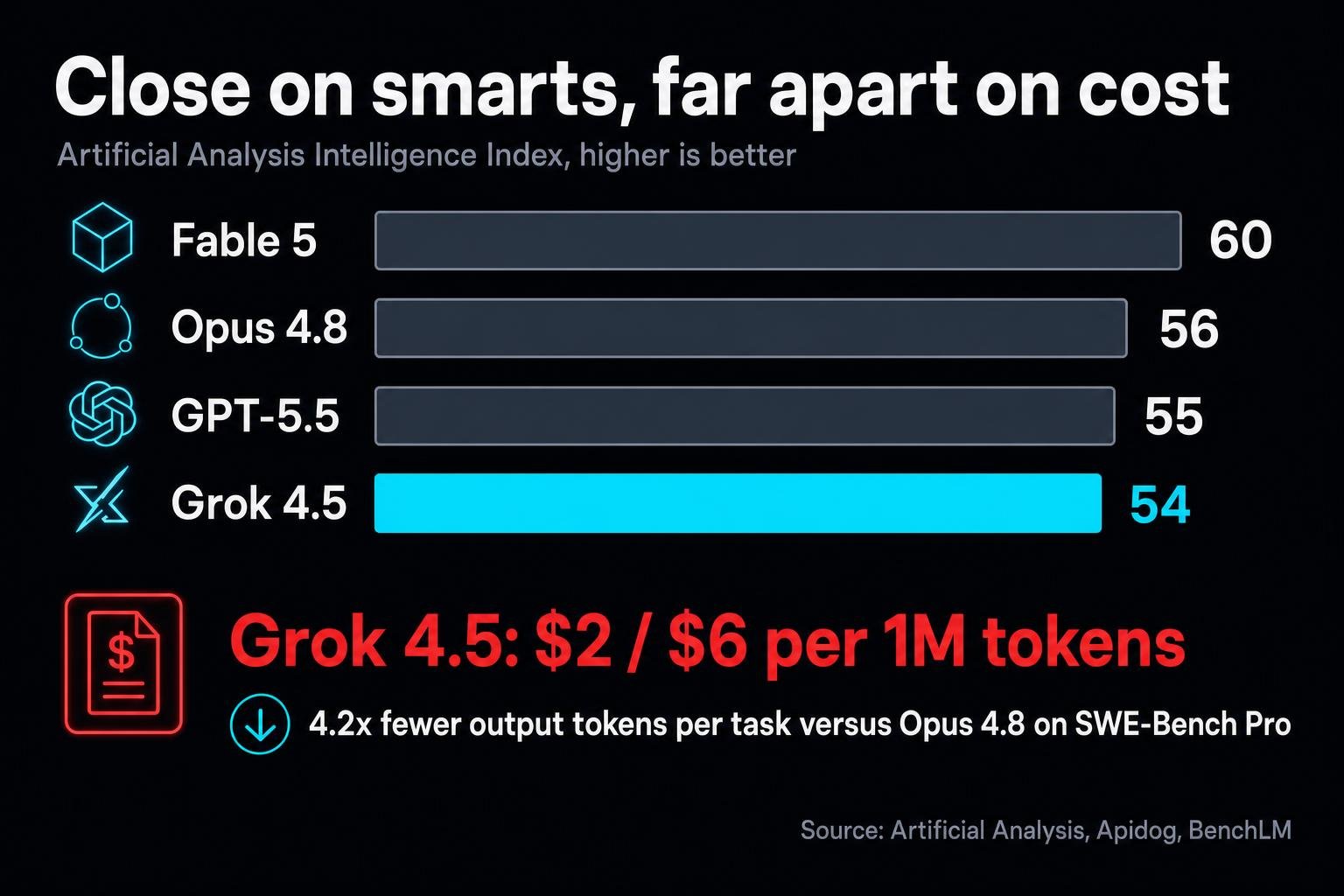
Grok 4.5 landed at number four on the Artificial Analysis Intelligence Index with a score of 54. Ahead of it sit Fable 5 at 60, Opus 4.8 at 56, and GPT-5.5 at 55. If the story ended there, this would be a footnote: another strong model, a few points off the lead. But the score is not where the story lives anymore.
Top speed versus fuel economy
Think about how we talk about cars. The number on the spec sheet, the top speed, is thrilling and almost entirely beside the point. What you actually pay for, mile after mile, is fuel economy. For AI models, the benchmark score is top speed. The output tokens a model burns to finish a task is fuel economy, and that is the bill that lands on your desk.
Here is where Grok 4.5 gets genuinely interesting. On SWE-Bench Pro, a coding benchmark, it scored 64.7% against Opus 4.8's 69.2%. It lost. But it did the work using 4.2 times fewer output tokens per task. It also won outright on DeepSWE 1.0 and Terminal Bench. And the price is aggressive: two dollars per million input tokens and six dollars per million output tokens.
A model that is five points behind on a benchmark but roughly four times cheaper on the tokens it actually consumes can win on economics alone.
That sentence is the whole shift. When you are running a model in a loop, an agent that reads, reasons, calls a tool, reads again, and repeats hundreds of times, the output tokens pile up fast. Efficiency there is not a rounding error. It is the difference between a workflow that pencils out and one that does not.
The frontier went four-way
For a while, choosing an AI model felt like picking a single champion. Now there are at least four credible contenders clustered near the top, and a busy mid-tier beneath them: GPT-5.6 Terra at $2.50/$15, GLM-5.2 at $1.40/$4.40, and now Grok 4.5 pushing frontier-adjacent quality down into a $2/$6 band. Google's Gemini 3.5 Pro was slated to arrive just days after Grok's launch, which would make it a genuine four-way race at the top.
So the question people ask is changing. It used to be "which frontier model is best?" Increasingly it is "which price-performance band fits this particular job?" A cheap, fast, token-thrifty model for high-volume grunt work. A pricier, sharper model for the hard reasoning that actually needs it. Picking the right model for each task is starting to look less like fandom and more like logistics: you do not send a moving truck to pick up a single envelope.
The Cursor detail worth watching
One structural note that is easy to skip past. Grok 4.5 was trained alongside Cursor, the AI coding editor that SpaceX agreed to acquire for $60 billion in June. It runs on xAI's 1.5-trillion-parameter V9 foundation.
Co-developing a model with the tool it lives inside is a pattern worth watching well beyond coding. When the model is trained together with its harness, the two fit each other in ways a general-purpose model bolted onto a random tool cannot easily match. If that co-development advantage proves real and durable, it becomes a competitive moat that has nothing to do with who tops the leaderboard this month.
What to actually take from this
Two things. First, the headline benchmark number is now the least interesting number in the announcement. If you are evaluating models for real work, measure tokens consumed per completed task, not just accuracy and not just the per-token sticker price. Those are two different questions, and the second one is where the money is.
Second, a caveat worth keeping honest. These figures come from xAI's own launch and early benchmark write-ups. The thing to watch is whether independent labs replicate the token-efficiency advantage, and whether it holds outside coding tasks, where it was measured. A 4.2x edge on software benchmarks does not automatically transfer to summarizing documents or answering support tickets. Until someone unaffiliated confirms it on varied workloads, treat it as a strong, testable claim rather than settled fact.
Still, the direction is clear. For a couple of years the story was a straight sprint toward the highest score. That race is not over, but a second one has opened up next to it, and it might matter more: not who is smartest, but who does the same work for a fraction of the cost.
One signal a day. No noise.
A 3-minute read when something genuinely shifts in AI, automation, or defense tech. Free, most weekdays.
Free, most weekdays. No spam, unsubscribe anytime.Sources
- Agentpedia - Grok 4.5, Cursor and the SpaceX/xAI launch - https://agentpedia.codes/blog/grok-4-5-cursor-spacexai-launch
- Fello AI - Grok 4.5 - https://felloai.com/grok-4-5/
- Apidog - Grok 4.5 benchmarks - https://apidog.com/blog/grok-4-5-benchmarks/
- Roo - Grok 4.5 - https://roo.beehiiv.com/p/grok-4-5
- Kingy - Grok 4.5 benchmarks, pricing, context window - https://kingy.ai/blog/grok-4-5-benchmarks-pricing-context-window/
- BenchLM - Grok 4.5 model page - https://benchlm.ai/models/grok-4-5
Quick answers
When did Grok 4.5 launch and how much does it cost?
xAI released Grok 4.5 on July 8, 2026. Pricing is two dollars per million input tokens and six dollars per million output tokens.
How does Grok 4.5 rank against other frontier models?
It sits at number four on the Artificial Analysis Intelligence Index with a score of 54, behind Fable 5 at 60, Opus 4.8 at 56, and GPT-5.5 at 55.
What is the 4.2x efficiency claim about?
On the SWE-Bench Pro coding benchmark, Grok 4.5 scored 64.7% versus Opus 4.8's 69.2% but used about 4.2 times fewer output tokens per task, which lowers the real cost of running it. The claim comes from xAI's launch data and still needs independent replication outside coding tasks.
Why do output tokens matter more than benchmark scores?
In agentic workflows that loop through many steps, output tokens are where costs accumulate. A model that is slightly behind on benchmarks but far cheaper per completed task can be the better economic choice for high-volume work.