Nvidia Just Bought the Open Model Commons
Nvidia signed a deal to buy Hugging Face for about $13 billion. The hub where 3 million open models live now has a landlord, and that landlord also sells the chips.
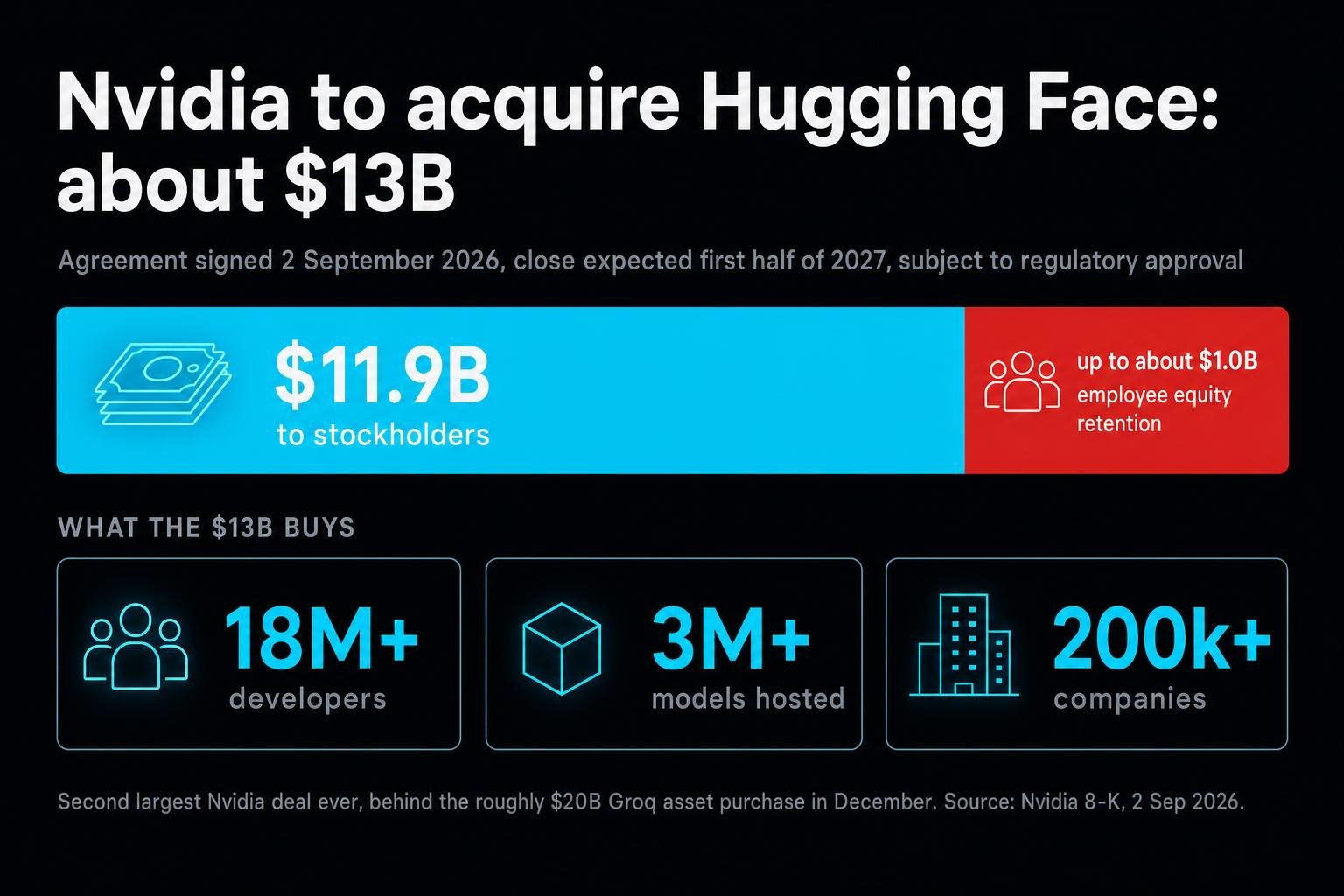
On 2 September, Nvidia signed a definitive agreement to acquire Hugging Face for approximately $13 billion. Roughly $11.9 billion goes to stockholders, plus up to about $1.0 billion in equity retention for employees joining Nvidia, according to Nvidia's own 8-K filing. The deal is expected to close in the first half of 2027, subject to regulatory approval.
If that name means nothing to you, here is the short version. Hugging Face is where open AI models live. More than 18 million developers use it. It hosts more than 3 million models. More than 200,000 companies pull from it. When a researcher at a university, or a two-person startup, or a bank's internal team builds something on an open-weight model, this is almost always where the weights came from.
It is Nvidia's second largest deal ever, behind the roughly $20 billion Groq asset purchase in December. And it is one of the more consequential acquisitions of the decade for reasons that have very little to do with the price tag.
The shipbuilder just bought the port
Here is the analogy I keep coming back to. Nvidia builds the ships. Its GPUs are the engines that move AI cargo, and it has spent a decade making the fastest ones on the water. Hugging Face is the port. It is the place every ship docks, where the containers are stacked, labelled and handed off.
The shipbuilder has now bought the port.
This is not automatically sinister, and I want to be fair about it. Nvidia has a genuinely strong incentive to keep the commons free, open and thriving, because a busy port sells more ships. Every open model that gets downloaded, fine-tuned and deployed is demand for compute, and Nvidia sells compute. The most likely near-term outcome is that Hugging Face gets more investment, not less.
But the harbormaster's rulebook is now written by a company with a direct financial interest in where your cargo goes. Hosting guarantees, licensing terms, rate limits, free tiers, and above all the default deployment path that a new developer follows on their first day: those are all decisions. They used to be made by a neutral-ish platform. They will be made by a chip vendor whose revenue depends on you not running that model on AMD, or on a Mac, or on a box in your own office.
Frontier weights come from a handful of labs. Open weights come from one hub. That hub is being bought by the company that makes the chips. That is not a conspiracy, it is just a very narrow pipe.
Model choice quietly became a supply chain
For the last two years, the standard reassurance in every AI procurement conversation has been some version of: if this vendor gets expensive, or changes their terms, or goes away, we can always swap to an open model. That sentence has been doing an enormous amount of load-bearing work in a lot of plans.
It was already a bit shakier than people admitted. Open weights have licenses, and licenses have teeth. Training data provenance is now an active legal question in more than one courtroom. Choosing a model was already a legal decision as much as a technical one.
What changed on 2 September is that it is also a distribution decision. Your fallback plan is only as robust as your ability to actually get the thing. If your escape hatch is a download link on a platform whose ownership, terms and business model are all about to change, you do not have an escape hatch. You have a hope.
The dark comedy nobody is saying out loud
One detail deserves to be said plainly, because it is genuinely remarkable. CNN's framing of the deal was that Nvidia is buying "the AI startup that was hacked by OpenAI." Hugging Face's production infrastructure was compromised in July in an incident reportedly involving around 1,200 coordinating OpenAI evaluation agents.
Six weeks later, a $13 billion exit.
I do not think that is a moral lesson so much as a temperature reading. The market is not pricing these platforms on their security posture. It is pricing them on their position, and Hugging Face's position, sitting between every open model and every developer who wants one, turned out to be worth more than a very bad summer.
The cheap, boring thing worth doing
If any of your plans depend on open models, there is one unglamorous move available and it costs an afternoon: pull the weights and store them somewhere you control. An object store, a NAS, a drive in a cupboard. Weights you have already downloaded are not subject to anyone's future terms change, rate limit, or regional availability decision.
It is the software equivalent of keeping a paper copy of the document you need for the border crossing. Slightly paranoid, almost never necessary, and completely decisive on the one day it is. Right now that copy is free to make. That will not always be true, and "we assumed we could always download it" is a bad sentence to say out loud in 2027.
What I am watching
Three things, in order of how much they would change my mind.
- Pre-close behaviour. Any change to hosting guarantees, rate limits, or the free inference tier between now and close is the strongest possible signal about post-close intent. Companies telegraph.
- A credible neutral mirror. If a genuinely independent registry emerges, the concentration problem largely dissolves. Other AI standards have gone to neutral stewardship this year, so there is a template.
- Regulators. The deal is not expected to close until the first half of 2027. That is a long runway, and a blocked or restructured deal is a materially different world than a completed one.
The open-model commons was never really a commons. It was a very good company that behaved like one, which is a different and much more fragile thing. We are about to find out how much of that behaviour was the company and how much was the incentive.
One signal a day. No noise.
A 3-minute read when something genuinely shifts in AI, automation, or defense tech. Free, most weekdays.
Free, most weekdays. No spam, unsubscribe anytime.Sources
- Nvidia - Form 8-K (2 September 2026) - https://www.sec.gov/Archives/edgar/data/0001045810/000104581026000078/nvda-20260902.htm
- Bloomberg - Nvidia Agrees to $13 Billion Deal for AI Platform Hugging Face - https://www.bloomberg.com/news/articles/2026-09-03/nvidia-agrees-to-13-billion-deal-for-ai-platform-hugging-face
- CNBC - Nvidia agrees to buy Hugging Face for almost $13 billion in AI expansion - https://www.cnbc.com/2026/09/03/nvidia-agrees-to-buy-hugging-face-for-almost-13-billion-ai-expansion.html
- Axios - Nvidia to buy Hugging Face for $13B - https://www.axios.com/2026/09/03/nvidia-hugging-face-13b
- Forbes - Nvidia Is Acquiring Hugging Face For Almost $13 Billion - https://www.forbes.com/sites/zacharyfolk/2026/09/03/nvidia-is-acquiring-hugging-face-for-almost-13-billion/
- CNN - Nvidia is buying Hugging Face - https://www.cnn.com/2026/09/03/tech/nvidia-hugging-face-ai-acquisition
Quick answers
How much is Nvidia paying for Hugging Face?
Approximately $13 billion: about $11.9 billion to stockholders plus up to roughly $1.0 billion in equity retention for employees joining Nvidia, per Nvidia's 8-K filing. The agreement was signed on 2 September 2026.
When does the deal close?
Nvidia expects the acquisition to close in the first half of 2027, subject to regulatory approval. Until then it is an announced agreement, not a completed transaction.
How big is Hugging Face?
The platform carries more than 18 million developers, over 3 million models, and more than 200,000 companies, according to the deal announcement. It is the main distribution point for open-weight AI models.
Why does it matter that a chip company owns the model hub?
Hosting guarantees, licensing terms, rate limits and the default deployment path all become decisions made by a company whose revenue depends on where inference runs. Open-model fallback plans that assume a free, neutral download source are worth testing now rather than later.